Jaldi-Vidhi

Court Design Handbook

Guidance for planning and designing accessible, safe and user-centred courts in India.

1

Court Design Handbook for District Courts in India

Court Design Handbook for District Courts in India

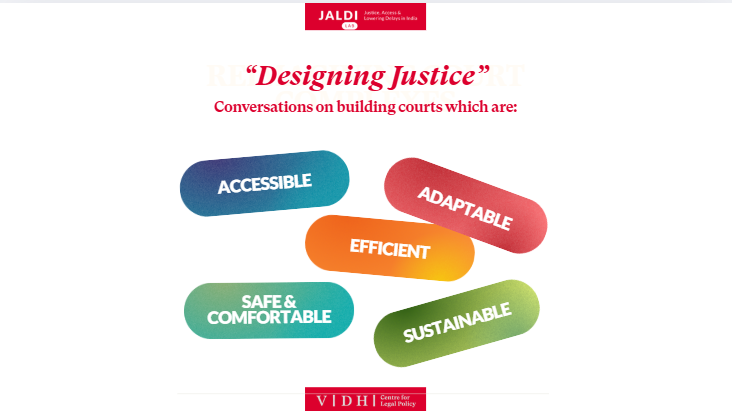
The Design Handbook seeks to envision and implement a user-centric District Court Complex responsive to the needs of all diverse users, i.e., litigants, judges, lawyers, Court staff, witnesses, accused persons, police, public visitors and other stakeholders in the justice system. A principles-based framework is used to highlight associated guidelines and design considerations, for creating truly inclusive, accessible, efficient, comfortable, adaptable, and sustainable Courts where the experience of seeking and providing justice is significantly improved.

Have Any Suggestions
https://docs.google.com/forms/d/e/1FAIpQLScw06cS4rU9am-ajQSbIe2bDgikjYlDFSGVK8hPGVGfeZF6Xw/viewform?usp=sf_link
Projects Authors And Acknowledgements
Shreya Tripathy is a Senior Resident Fellow at Vidhi Centre for Legal Policy working as part of the Justice, Access, and Lowering Delays in India (JALDI) Initiative. Priyamvadha Shivaji is a Research Fellow at Vidhi Centre for Legal Policy working as part of the Justice, Access, and Lowering Delays in India (JALDI) Initiative. Brinda Sastry is an architect, urban designer, and planner with experience in formulating policies, audit frameworks, and design guidelines, with a participatory approach, to ensure inclusive and equitable design of public places. Shreya Shetty is an architect and urban design consultant, Co-Founder of 369 Ochre Studio who assisted in drafting the Harmonised Guidelines & Standards for Universal Accessibility in India 2021, drafted by the National Institute of Urban Affairs (NIUA) & Indian Institute of Technology, Roorkee released by Central Public Works Department, Government of India under Ministry of Housing and Urban Affairs. Bhagyalaxmi Madapur , Co-Founder of 369 Ochre Studio in Bengaluru, India, is an architect and urbanist who worked as a contract consultant with the Asian Development Bank (ADB) on the project "Sponge City: Towards Building Flood Resilient Kolkata," which involved creating educational materials-infographic handbooks, videos, and brochures aimed at strengthening the capacity of Kolkata Municipal Corporation for resilient urban services. Abubakar Shaikh is an architect and Art Lead at Autovrse. Gayatri Ganesh is an architect and Experience Designer at Autovrse. Milind D.P. is the Executive Vice President, Consultancy & Projects, BNA Technology Consulting Ltd. His division is focused on IT Infrastructure Design, Project Management and Monitoring of ICT Projects. Arun Kumar is an acoustic consultant at HMPL Consulting Pvt Ltd, Bangalore, with over 8 years of expertise in Architectural, Environmental, and Industrial Acoustics, dedicated to shaping sound environments for optimal experiences. Akshatha Hariharan is an architect exploring the realms of Visual & User experience design. Rama Raghavan is an Architectural writer and researcher based in Pune. As a pedagogue, she has curated courses in Accessibility and Universal Design. She has worked on several publications that intricately connect the built environment with socio-spatial dimensions. This report has been in the making for over two years and owes a great deal to the inputs provided by a multitude of people. The authors would like to thank the following: Deepika Kinhal (Team Lead, JALDI) for her guidance throughout the project and for reviewing the report. The authors are also grateful to Reshma Sekhar (Former Senior Resident Fellow, JALDI) for her contribution to the conceptualisation of the Handbook. Dr. Gaurav Raheja (Professor of Architecture, IIT Roorkee) and Dr. Rahela Korakhiwala (Author, From the Colonial to the Contemporary: Images, Iconography, Memories, and Performances of Law in India's High Courts) for their guidance in the conceptualisation stage. Justice Badar Durrez Ahmad (Former Chief Justice, Jammu & Kashmir High Court), Justice Ponugoti Naveen Rao (Former Acting Chief Justice, Telangana High Court) and Mr. Suresh Kogilgere (Former Registrar, Karnataka High Court) for their inputs for the project. Dr. Tanya Machado (Professor of Clinical Psychology (Rtd). Consultant Clinical Psychologist) and Dr. Ria Fernandez (Rehabilitation Specialist, Mazumdar Shaw Hospital) for their inputs on child-friendly design and providing trauma-informed design considerations for vulnerable witnesses. Akhilesh (Project Second Chance) for his inputs on safe, secure, and humane design considerations for accused persons. Nilesh Singit (independent accessibility expert) and Dr. Sanjay Jain (Professor at National Law School of India University, Bengaluru), members of the Supreme Court Committee on Accessibility, for their inputs on ensuring universal accessibility. Alok Prasanna Kumar (Co-founder and Team Lead, Vidhi Karnataka), and Vidhi Fellows Manmayi Sharma (Senior Resident Fellow, Disability Inclusion & Access), Yashaswini Basu (Outreach Lead, Nyaaya), Yogini Oke (Impact and Partnerships Fellow), Shireen Yachu (Communications Fellow, Impact Collective) and Somya Jain (Research Fellow, Disability Inclusion & Access) for their inputs on the project. Damini Ghosh (Team Lead, Disability, Inclusion & Access at Vidhi) and Prof. Sanjay Kanvinde (Senior Partner, Kanvinde Rai & Chowdhury) for peer-reviewing the Handbook and providing their invaluable feedback. Over the months of February and March 2024, four round-table consultations were held with experts from various fields, on the following themes covered in the Handbook: Institutional capacity building; Making District Courts safe, secure and comfortable; Incorporating Universal Design Principles; and Facilitating efficient and future-ready Court Complexes. The authors would like to thank the following participants for their inputs during the sessions: Justice (retd.) Ponugoti Naveen Rao (former acting Chief Justice at Telangana High Court), Prof. Jyoti Dogra (Professor at Indian Law Institute), Dr. Sheila Ramaswamy (Technical & Operational Lead at NIMHANS), Ms. Arushi Anthwal (Legal Counsel at Counsel to Secure Justice), Ms. Kushi Kushalappa (Director, Support & Rehabilitation at Enfold India), Ms. Shirisha Reddy (Program Manager at Nyaaya Kannada), Mr. Amar Jain (co-founder at Mission Accessibility), Ms. Anita Iyer Narayan (Managing Trustee, sponsor and volunteer at Ekansh Trust), Prof. Gaurav Raheja (Professor Incharge, Inclusion & Accessibility Services at IIT Roorkee), Ms. Nivedita Krishna (founder-director at PACTA), Ms. Pooja Sastry (PhD candidate in architectural history at University College, Dublin), Ms. Shruti Dixit (practising lawyer in Lucknow), Mr. Akshay Jain (Assistant Program Manager at National Centre for Promotion of Employment for Disabled People), Mr. Rahul Bajaj (co-founder at Mission Accessibility) and Mr. R. Sri Kumar (former Head of Police Force in Karnataka and former Chief Vigilance Commissioner). The Vidhi Centre for Legal Policy is an independent think-tank doing legal research to make better laws and improve governance for the public good. The JALDI Initiative is a multi-year initiative that aims to advocate for and implement evidence-based reforms to eliminate the existing backlog in Courts and ensure that cases are disposed within reasonable timelines. This report is under the aegis of JALDI Innovation Lab, a multi-disciplinary collaborative of experts to design solutions for the justice delivery systems in India. Errors, if any, rest with the authors. Contact us at jaldi@vidhilegalpolicy.in
Sub Project Title
Design Guide for User-Centric Court Complexes

design

law

Content image 1
Jaldi Lab Aspect Title
Design

Design

Design-thinking and architecture to transform how accessing justice looks and feels

Content image 1
Jaldi Lab Aspect Title
Law

Law

Rules and policies to guide implementation of reforms in a fair, just and transparent manner.

Project Videos

Introduction to the series

Introduction to the series

Introduction to the series

How can we improve e-Filing in courts?

How can we improve e-Filing in courts?

How can we improve e-Filing in courts?

&.bold-text

&:first-child

&:last-child

Lato

&:nth-of-type(even)

nearest

smooth

The Legal Service Authorities Act 1987, s. 12.

Constitution of India 1950, art. 39A.

The Legal Services Authorities Act 1987.

S.9.

District Legal Services Authority.

(2) A District Authority shall consist of—

(a) the District Judge who shall be its Chairman; and

(b) such number of other members, possessing such experience and qualifications, as may be prescribed by the State Government, to be nominated by that Government in consultation with the Chief Justice of the High Court.

(3) The State Authority shall, in consultation with the Chairman of the District Authority, appoint a person belonging to the State Judicial Service not lower in rank than that of a Subordinate Judge or Civil Judge posted at the seat of the District Judiciary as Secretary of the District Authority to exercise such powers and perform such duties under the Chairman of that Committee as may be assigned to him by such Chairman.

(5) The District Authority

may appoint such number of officers and other employees as may be prescribed by the State Government

in consultation with the Chief Justice of the High Court for the efficient discharge of its functions.

The Legal Services Authority must have its own office space with adequate space for the Chairman, and other members and staff as prescribed by the State Government.

The office of the Chairman may be designed similarly to the office space provided for the Judges of the Court (See:

Section 2.4.A

S.10.

Functions of the District Authority.

(2) Without prejudice to the generality of the functions referred to in sub-section (1), the District Authority may perform all or any of the following functions, namely:—

(a) coordinate the activities of the Taluk Legal Services Committee and other legal services in the District;

(b) organise Lok Adalats within the District; and

(c) perform such other functions as the State Authority may fix by regulations.

The DLSA may have adequate space within or in close proximity to its premises, for conducting Lok Adalats and legal awareness camps.

Users

Chairman

Secretary

Members

Staff

Advocates

Litigants

General Public

Objectives

Ensure that the space is

accessible for diverse user groups

including Persons with Disabilities, elderly, expectant mothers, children, etc.;

Design spaces to

encourage persons with limited resources to seek help

in their litigation processes;

Ensure that the spaces are

non-intimidating, inviting, open, and accommodating

for all parties;

Ensure

efficient functioning by providing adequate space

to accommodate all the functions of the DLSA;

enable confidential conversations

between the litigants and their Advocates, when necessary; and

Ensure that the spaces have

adequate security provisions and fire safety measures

Adjacencies

The DLSA may be its own self-sustained space within the Court Complex site. It must be in close proximity to the entrance of the Court Complex to ensure convenient access for litigants.

In such instances where the DLSA is part of the Court Complex, it must be in close proximity to the entrance and to the public waiting areas.

It may be in close proximity to the e-Seva Kendra.

Design Considerations

The relevant provisions of the Legal Services Authorities Act, 1987 which pertain to infrastructural requirements are:

Table 13:

Design considerations arising from the Legal Services Authorities Act (1987).

Section

Section Title

Details

Design Consideration

The DLSA must be clearly marked out by the use of accessible informational and directional signage.

It must have a reception area at the entrance to the DLSA premises, as well as adequate waiting areas for the litigants visiting the premises.

Accessible information counters/kiosks/pamphlets must be provided, in local languages, for the public to get information regarding their rights.

An attached kitchen/pantry area, accessible and family-friendly toilets, and drinking water facilities must be provided.

All spaces within the DLSA must be accessible to diverse user groups, and must be equipped with ramps and elevators, accessible signage, tactile paths, etc.

The space may be designed using natural elements, adequate windows and lighting, comfortable seating and indoor plants and greenery to ensure comfort for all users.

Waiting Room

Waiting areas for litigants must have dedicated information kiosks providing information regarding the various cases that are being undertaken by the DLSA.

Information screens providing accessible information regarding the rights of the citizens for legal aid, in local languages, must also be provided.For further details on the design of waiting areas, please refer to

Section 2.2.

Reception Area

The DLSA must have its own dedicated reception area with a counter.

The reception must be manned by at least one receptionist for aiding litigants with proceedings referred for legal aid.

The receptionist/information kiosks at the reception must be equipped to provide information to the litigants regarding their rights to legal aid, its benefits and information regarding the various events being undertaken by the Authority.

Office Spaces

A separate office space must be provided for the District Judge who is the ex-officio Chairman of the DLSA, designed in accordance with the design considerations highlighted in

Separate, comfortable workspaces must be provided for the DLSA members, staff, and empanelled Advocates. For further details on the design of single-person and multi-person office spaces, please refer to

Section 2.5.B

and

2.5.C.

Workspaces for empanelled Advocates must additionally be equipped with provision for a secure, private meeting area with litigants.

Separate meeting rooms must be provided to facilitate meetings between the empanelled Advocates and the litigants. The rooms should be acoustically treated to ensure privacy and confidentiality. For further details on acoustics, please refer to

Annexure 5.

PART C - THE HANDBOOK

ORGANIZATION AND DESIGN OF SPACES OF THE COURT COMPLEX

2.8.

Para-Legal Facilities

B. Legal Services Authority

Legal Aid Services are facilities provided in the District Courts through which state-funded legal aid is provided to persons “who have to file or defend a case”.

The Constitution of India mandates the provision of free legal aid to every citizen,

which has been understood as comprising a crucial part of the fundamental right to life and liberty under Articles 21 and 22. The Legal Services Authority Act, 1987 was instituted to put in place a structure for the execution of this provision.

At the District Court level, every District Court is required to have District Legal Services Authorities (“DLSA”) for the dispensation of this function. The Centres provide free and competent legal counselling and advice, conduct Lok Adalats, free legal assistance to persons who qualify for the same under the Act, and undertake programs to increase the legal awareness among the common public.

The DLSA offices must have adequate space to accommodate all of the above-mentioned functions. There must also be adequate space to ensure comfortable workspaces for the office-holders, staff and Advocates associated with the Centre.

References

justified

GT Super Text

1px solid lightGray

lato

& .

Source:

black

item-

subItem-

nestedItem-

square

1px solid red

Image Credit:

red