Jaldi-Vidhi

Court Design Handbook

Guidance for planning and designing accessible, safe and user-centred courts in India.

1

Court Design Handbook for District Courts in India

Court Design Handbook for District Courts in India

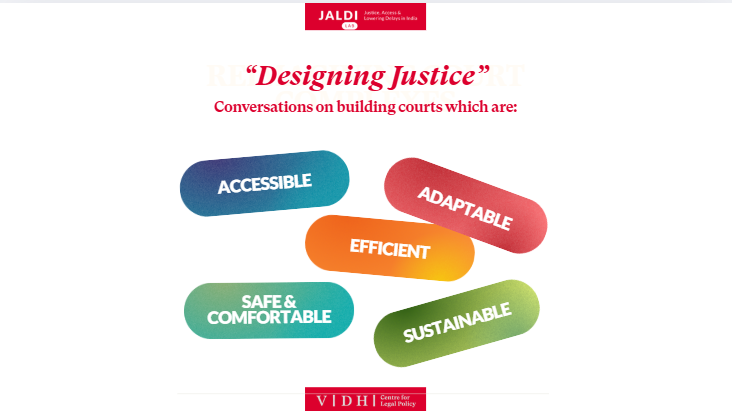
The Design Handbook seeks to envision and implement a user-centric District Court Complex responsive to the needs of all diverse users, i.e., litigants, judges, lawyers, Court staff, witnesses, accused persons, police, public visitors and other stakeholders in the justice system. A principles-based framework is used to highlight associated guidelines and design considerations, for creating truly inclusive, accessible, efficient, comfortable, adaptable, and sustainable Courts where the experience of seeking and providing justice is significantly improved.

Have Any Suggestions
https://docs.google.com/forms/d/e/1FAIpQLScw06cS4rU9am-ajQSbIe2bDgikjYlDFSGVK8hPGVGfeZF6Xw/viewform?usp=sf_link
Projects Authors And Acknowledgements
Shreya Tripathy is a Senior Resident Fellow at Vidhi Centre for Legal Policy working as part of the Justice, Access, and Lowering Delays in India (JALDI) Initiative. Priyamvadha Shivaji is a Research Fellow at Vidhi Centre for Legal Policy working as part of the Justice, Access, and Lowering Delays in India (JALDI) Initiative. Brinda Sastry is an architect, urban designer, and planner with experience in formulating policies, audit frameworks, and design guidelines, with a participatory approach, to ensure inclusive and equitable design of public places. Shreya Shetty is an architect and urban design consultant, Co-Founder of 369 Ochre Studio who assisted in drafting the Harmonised Guidelines & Standards for Universal Accessibility in India 2021, drafted by the National Institute of Urban Affairs (NIUA) & Indian Institute of Technology, Roorkee released by Central Public Works Department, Government of India under Ministry of Housing and Urban Affairs. Bhagyalaxmi Madapur , Co-Founder of 369 Ochre Studio in Bengaluru, India, is an architect and urbanist who worked as a contract consultant with the Asian Development Bank (ADB) on the project "Sponge City: Towards Building Flood Resilient Kolkata," which involved creating educational materials-infographic handbooks, videos, and brochures aimed at strengthening the capacity of Kolkata Municipal Corporation for resilient urban services. Abubakar Shaikh is an architect and Art Lead at Autovrse. Gayatri Ganesh is an architect and Experience Designer at Autovrse. Milind D.P. is the Executive Vice President, Consultancy & Projects, BNA Technology Consulting Ltd. His division is focused on IT Infrastructure Design, Project Management and Monitoring of ICT Projects. Arun Kumar is an acoustic consultant at HMPL Consulting Pvt Ltd, Bangalore, with over 8 years of expertise in Architectural, Environmental, and Industrial Acoustics, dedicated to shaping sound environments for optimal experiences. Akshatha Hariharan is an architect exploring the realms of Visual & User experience design. Rama Raghavan is an Architectural writer and researcher based in Pune. As a pedagogue, she has curated courses in Accessibility and Universal Design. She has worked on several publications that intricately connect the built environment with socio-spatial dimensions. This report has been in the making for over two years and owes a great deal to the inputs provided by a multitude of people. The authors would like to thank the following: Deepika Kinhal (Team Lead, JALDI) for her guidance throughout the project and for reviewing the report. The authors are also grateful to Reshma Sekhar (Former Senior Resident Fellow, JALDI) for her contribution to the conceptualisation of the Handbook. Dr. Gaurav Raheja (Professor of Architecture, IIT Roorkee) and Dr. Rahela Korakhiwala (Author, From the Colonial to the Contemporary: Images, Iconography, Memories, and Performances of Law in India's High Courts) for their guidance in the conceptualisation stage. Justice Badar Durrez Ahmad (Former Chief Justice, Jammu & Kashmir High Court), Justice Ponugoti Naveen Rao (Former Acting Chief Justice, Telangana High Court) and Mr. Suresh Kogilgere (Former Registrar, Karnataka High Court) for their inputs for the project. Dr. Tanya Machado (Professor of Clinical Psychology (Rtd). Consultant Clinical Psychologist) and Dr. Ria Fernandez (Rehabilitation Specialist, Mazumdar Shaw Hospital) for their inputs on child-friendly design and providing trauma-informed design considerations for vulnerable witnesses. Akhilesh (Project Second Chance) for his inputs on safe, secure, and humane design considerations for accused persons. Nilesh Singit (independent accessibility expert) and Dr. Sanjay Jain (Professor at National Law School of India University, Bengaluru), members of the Supreme Court Committee on Accessibility, for their inputs on ensuring universal accessibility. Alok Prasanna Kumar (Co-founder and Team Lead, Vidhi Karnataka), and Vidhi Fellows Manmayi Sharma (Senior Resident Fellow, Disability Inclusion & Access), Yashaswini Basu (Outreach Lead, Nyaaya), Yogini Oke (Impact and Partnerships Fellow), Shireen Yachu (Communications Fellow, Impact Collective) and Somya Jain (Research Fellow, Disability Inclusion & Access) for their inputs on the project. Damini Ghosh (Team Lead, Disability, Inclusion & Access at Vidhi) and Prof. Sanjay Kanvinde (Senior Partner, Kanvinde Rai & Chowdhury) for peer-reviewing the Handbook and providing their invaluable feedback. Over the months of February and March 2024, four round-table consultations were held with experts from various fields, on the following themes covered in the Handbook: Institutional capacity building; Making District Courts safe, secure and comfortable; Incorporating Universal Design Principles; and Facilitating efficient and future-ready Court Complexes. The authors would like to thank the following participants for their inputs during the sessions: Justice (retd.) Ponugoti Naveen Rao (former acting Chief Justice at Telangana High Court), Prof. Jyoti Dogra (Professor at Indian Law Institute), Dr. Sheila Ramaswamy (Technical & Operational Lead at NIMHANS), Ms. Arushi Anthwal (Legal Counsel at Counsel to Secure Justice), Ms. Kushi Kushalappa (Director, Support & Rehabilitation at Enfold India), Ms. Shirisha Reddy (Program Manager at Nyaaya Kannada), Mr. Amar Jain (co-founder at Mission Accessibility), Ms. Anita Iyer Narayan (Managing Trustee, sponsor and volunteer at Ekansh Trust), Prof. Gaurav Raheja (Professor Incharge, Inclusion & Accessibility Services at IIT Roorkee), Ms. Nivedita Krishna (founder-director at PACTA), Ms. Pooja Sastry (PhD candidate in architectural history at University College, Dublin), Ms. Shruti Dixit (practising lawyer in Lucknow), Mr. Akshay Jain (Assistant Program Manager at National Centre for Promotion of Employment for Disabled People), Mr. Rahul Bajaj (co-founder at Mission Accessibility) and Mr. R. Sri Kumar (former Head of Police Force in Karnataka and former Chief Vigilance Commissioner). The Vidhi Centre for Legal Policy is an independent think-tank doing legal research to make better laws and improve governance for the public good. The JALDI Initiative is a multi-year initiative that aims to advocate for and implement evidence-based reforms to eliminate the existing backlog in Courts and ensure that cases are disposed within reasonable timelines. This report is under the aegis of JALDI Innovation Lab, a multi-disciplinary collaborative of experts to design solutions for the justice delivery systems in India. Errors, if any, rest with the authors. Contact us at jaldi@vidhilegalpolicy.in
Sub Project Title
Design Guide for User-Centric Court Complexes

design

law

Content image 1
Jaldi Lab Aspect Title
Design

Design

Design-thinking and architecture to transform how accessing justice looks and feels

Content image 1
Jaldi Lab Aspect Title
Law

Law

Rules and policies to guide implementation of reforms in a fair, just and transparent manner.

Project Videos

Introduction to the series

Introduction to the series

Introduction to the series

How can we improve e-Filing in courts?

How can we improve e-Filing in courts?

How can we improve e-Filing in courts?

nearest

smooth

For example, in 2015, a sniffer dog squad was brought to the Bombay High Court building to detect a possible bomb threat.

NCMS Action Plan

eCommittee of Supreme Court of India, ‘Policy and Action Plan Document: Phase II of the eCourts Project’ (2014)

eCommittee of Supreme Court of India, ‘Policy and Action Plan Document: Phase II of the eCourts Project’ (2014) p. 7.

eCommittee of Supreme Court of India, ‘Newsletter’ (November 2023)

p. 31.

eCourts Phase III Vision Document.

eCommittee of Supreme Court of India, ‘eCourts Project Phase II: Objectives Accomplishment Report as per Policy Action Plan Document’

Justice K.S. Puttaswamy (Retd.) & Anr. v. Union of India

(2017) 10 SCC 1 (Supreme Court of India).

Digital Personal Data Protection Act (2023), section 4.

Screening of both vehicles and users at two levels:

Perimeter screening before entry into the sanitised area of the Court Complex (

PART C, Sections 1.2 and 1.3

); and

Frisking with baggage and full body scanners before entry into any designated secure area of the Court building (

PART C, Sections 1.2, 1.4-1.5

Securing the building entrances and paths/lifts for judges, accused persons and vulnerable witnesses through use of CCTV surveillance systems.

Using technologically advanced access control mechanisms with biometric or touch-free facial/retina screening at entry points to high security areas, such as the lock-ups and evidence storage rooms (

PART C, Sections 2.7.A

and

2.9.D

Within the Courtrooms and VWDCs, providing security features such as tinted glass for the accused to avoid direct confrontation with vulnerable witnesses (

PART C, Sections 2.1.B

Section 2.3

Adopting additional security subsystems such as mobile sniffers with signatures of explosives and chemical compounds, Hold and Disposal Bags for covering suspicious unhandled baggage or perceived explosives, etc., depending on threat perceptions, particularly for Courts in border states or states with insurgency/naxalite threats.

For further details, please refer to

Annexure 3

Coordinating with the Command and Control Centre for monitoring security protocols and undertaking coordinated evacuation activities (

PART C, Section 2.5.C

PART D - IMPLEMENTATION, MONITORING & EVALUATION

RECOMMENDED MANAGEMENT POLICIES & STRATEGIES

This section lays down the policies and strategies that may be put in place to implement the recommendations provided in this Handbook. The policies and strategies have been recommended to aid the High Court Building Committees to look at District Court infrastructure in a holistic manner and to ensure that they formulate strategies and implementation policies with the long-term aim of ensuring accessible, adaptable, efficient, safe and comfortable, and sustainable judicial infrastructure. The recommended policies take into account existing standards and procedures and provide additional components to be taken into consideration wherever necessary.

Action:

Process and Implementation:

Monitoring and Evaluation:

4.1.

Components of Security Policy for the District Judiciary

To ensure optimal use of the proposed systems and sub-systems, a Security and Administration Policy should be put in place after undertaking a review of the applicable (bye-)laws and regulations for each Court Complex in a particular jurisdiction. A Security Committee may be constituted at each High Court to undertake this exercise.

The Committee may be structured to consist of representatives of the District Courts, the jurisdictional law enforcement agency, and the potential service providers of the sub-systems, including IT & Networking, Fire & Safety, Security, Facility Management System & Parking Management System as well as representatives of the Government Service Departments at the State-level such as the National Informatics Centre (“NIC”), the Centre for Development of Advanced Computing (“C-DAC”), Central Reserve Police Force (“CRPF”), Central Industrial Security Force (“CISF”), etc., who will render services to the Court.

The Committee should periodically review the threat perception to the Court Complex and create Standard Operating Procedures (“SOPs”) and protocols for achieving its security goals. It should also regularly liaise with state & city law enforcement agencies, District Disaster Management Authorities and the Fire & Civil Defence Bodies while creating the SoPs.

SOPs may be formulated to asses the following aspects:

4.2.

Data Management Policies for the District Judiciary

A. Systems for e-Courts Management

The use of Information & Communication Technology (“ICT”) in Court Complexes enables a seamless transition from a physical to a virtual Court. The e-Committee of the Supreme Court is tasked with overseeing the development of networking infrastructure and the adoption of digitisation of Court processes, with the aim of making the system accessible, cost-effective, efficient, transparent, and accountable.

The Policy and Action Plan of the National Court Management System Committee (NCMS Committee)

recommended setting up measurable performance standards for Courts, adoption of case management systems, standardisation of judicial data and statistics, and adoption of a human resource plan for Courts.

However, the Phases I & II of the e-Courts project have not been very successful in ensuring that the benefits reach end-users, owing to uneven distribution of hardware and ICT resources,

and reluctance at the ground-level to adopt new technologies being introduced such as e-filing or National Service and Tracking of Electronic Processes (“N-STEP”), with users continuing to prefer traditional methods.

Phase III of the e-Courts Project has provided a unique opportunity to ensure that the policies envisioned in the earlier phases are actualised and end-users directly benefited. The 2023 Vision Document of Phase III articulates goals for putting in place digital infrastructure and services guided by core values of trust, empathy, sustainability, and transparency. It takes an “ecosystem approach” that leverages existing capacities in different stakeholders to realise its vision.

To operationalise these goals and the proposed “ecosystem approach”, the institutional and governance framework recommended in this Vision Document must be implemented by setting up the recommended Digital Courts Technology Office (“DCTO”) in the transitory stage, which will evolve to a statutory body, the National Judicial Technology Council (“NJTC”) that will focus on designing the Digital Infrastructure based on consultations with all necessary stakeholders.

An efficient feedback mechanism should be set up to strengthen the feedback loops, ensure competencies and create clear accountability mechanisms for making justice more accessible, inclusive and efficient for everyone while adopting the innovative diverse solutions. For further details, please refer to

Section 6

Additionally, Hardware Infrastructure Systems, including physical wired and wireless infrastructure should be compliant as per the relevant Telecommunications Industry Association (“TIA”) Standards and Building Industry Consulting Service International (“BICSI”) recommendations.

All Systems, Sub-systems and Devices deployed for automation of the in-premises services described under D 1, 2 & 3, should support appropriate APIs, preferably based on Open IOT platform standards, for smooth integration to a future Digital Public Infrastructure (“DPI”) based on e-Courts Management systems.

B. Data and Records Management

Phases I and II of the e-Courts project of the e-Committee of the Supreme Court recommended the implementation of data management systems to develop Common Application Software with the help of the e-Committee for all District Courts, to ensure uniform structures through national codification processes for data collection.

To ensure that this is actualised, a comprehensive Data and Records Management Policy must be put in place to guide the digitisation efforts at the High Court and District Court level.

Documentation of records (including pleadings, evidence, orders and judgments) involves indexing, authentication, and conversion of files into digital formats. Additionally, plaints, petitions, appeals and applications filed digitally via the e-Seva Kendra also need systems for generating receipts and stamps, and scrutinizing and preparing digital files. The recommended document management system should take these requirements into account and should be integrated with the overarching Case Management System of the Court.

The Policy must also account for procedures for the retention, proper handling, and disposal of property and evidence. An evidence management system with advanced electronic mechanisms such as barcodes or Radio Frequency Identification (“RFID”) chips may be considered for efficient and secure management of evidence in Evidence Rooms (

PART C, Section 2.9.D

Additionally, procedures for disposal of seized evidence in disposed cases must be put in place to maintain privacy and confidentiality of information along with mechanisms for archival of records, in accordance with the existing Civil and Criminal Rules of Procedure in each jurisdiction.

Digitisation must also ensure that the data collected from all users may be made available in perpetuity while maintaining the sanctity of the data. While replicating an on-premise digital store onto a cloud infrastructure is the basic expectation, the DCTO must put in place protocols and integrate technologies such as Storage Area Network (“SAN”) servers for regular backups, data mirroring and cross cloud data management. The protocols should include retrieval of data from such backups as well as periodic data vulnerability assessments and Information Security Audits. Provisions should be made at the digitisation stage to account for these processes and the accompanying digital infrastructure that must be incorporated at the District Courts.

While the guiding principle behind digitisation of data is accessibility & inclusiveness, Personal Data Protection & need based access must be an important consideration in compliance with the Supreme Court guidelines in the

Puttaswamy

case

and the Digital Personal Data

Protection Act (2023).

This becomes even more paramount once the “ecosystem” approach proposed in the Vision Document becomes widespread and multiple external stakeholders start gaining access to judicial data & personal information of litigants and witnesses.

References

Lato

justified

GT Super Text

1px solid lightGray

lato

& .

Source:

black

item-

subItem-

nestedItem-

square

1px solid red

Image Credit:

red