- Message
- show
Jaldi-Vidhi
State of Punjab v. Davinder Singh
Case details and hearing information from the Constitution Bench Pendency Portal.
589
State of Punjab v. Davinder Singh
This case deals with the issue of sub-classification within the seats reserved for Scheduled Castes in the state of Punjab.
- Petitioners Arguments
- The decision in E.V. Chinnaiah is erroneous as: The premise of giving preference to certain Scheduled Castes tinkers with the Presidential List is incorrect as there is no inclusion or exclusion of any caste in the list. Nothing under Article 341 prohibits preferential treatment nor takes away power of a state under Article 16(4) to make provisions for the same. The court did not interpret Indra Sawney correctly on sub-classification. Since the majority decision permitted classification of backward classes into backward and more backward and Scheduled Castes also fall within backward classes; therefore such classification is permitted. The decision is contrary to K.C. Vasanth Kumar and has not appreciated M.R. Balaji and N.M. Thomas on the need of sub-classification and its permissibility respectively. Treating Scheduled Castes as a homogenous class is removed from social and economic reality.as evidenced by State data documentation and will deprive them of rights under Articles 14 and 16. The decision is not absolute as a stare decisis. The legal fiction created under Article 341 is limited to specification of castes which will not be disturbed by sub-classification. State cannot be restricted by Article 46. The decision will challenge the validity of Article 342A (inserted by the 102nd constitutional amendment). Tthe Punjab Act has been enacted under Article 16(1) and 16(4) read with Articles 245 and 246 and is therefore within legislative competence of the State. Article 16(4) covers Scheduled Castes Preferential treatment to certain Scheduled Castes/Scheduled Tribes does not violate Article 14 as it is based on intelligible differentia which bears reasonable nexus with the object of equitable representation of all Scheduled Castes in Government service. In Jarnail Singh it was held that all backward classes will not be equal if only a selective few get selected in all the coveted services of the Government. Applying creamy layer concept to Articles 341 and 342 does not tinker with the Presidential List in this case and M. Nagaraj . The State has a huge role to play in the reservation process as per Articles 16(4), 16(4A), 335, 341, and 342 which would be denied if power to make preference is denied. The power of state under 15(4) and 16(4) is not limited by main provisions. A class cannot be backward in perpetuity and must be judged by existing situations as per Jagdish Negi, President, Uttarakhand Jan Morcha & Anr. v. State of U.P. & Anr. The State of Tamil Nadu had also created a similar distinction for Arunthathiyars. Therefore their counsels argued on similar lines and additionally that: Legislative competence flows from Article 246(2) and 246(3) read with Entry 41 in List II and Entry 25 in List III and, this is not abrogated by Article 341. The report of Justice M.S. Janarthanam Committee of Inquiry for Special Reservation for the Arunthathiyars and Justice Ramachandra Raju Committee for Reli community showed the lower extent of availing reservations within this caste.
- Responders Arguments
- Only the Parliament can exclude castes from the list. According to rule of binding precedent E.V. Chinnaiah cannot be overruled except for exceptional circumstances and unforeseeable consequences would follow. Indra Sawhney was understood correctly as none of its observations would apply to Scheduled Castes. In N.M. Thomas sub-classification was held to be impermissible as exclusion from the list is the Parliament' s prerogative, and no alteration and inquiry into the same is permitted. The legal fiction under Article 341 is to be given full effect. Scheduled Castes are different from other backward classes and Article 16(4) cannot be exercised de-hors Article 341. M. Nagaraj ought to be referred to a larger bench as it has taken a view opposite of the majority view in Indra Sawnhey and the decision has been doubted in many cases afterwards.
- Last Listed On
- 2024-08-01
- Start Date
- 2020-08-27
- End Date
- 2024-08-01
- Card Stage Date
- 2024-08-01
- Review Petition No
- C.A. No. 2317/2011
- Case Status
- Archive
- Bench Status
- Constituted
- Subject Matter
- Constitution
- Comment
- NA
- Disposal Time
- 3 years, 11 months, 6 days
7 Judge Bench
Judgment delivered
- Consider As Stage Of Pendency
- false
Date of institution of case
Date of reference to 5 Judge Bench
Date of reference to 7 Judge Bench
Judgement pronounced
The Punjab Government sought to reserve 50% seats from the Scheduled Castes category to Balmikis and Mazhabi Sikhs via a circular dated 5.5.1975. This circular was struck down by the Division Bench of the Punjab and Haryana High Court on 25.7.2006. The Supreme Court also dismissed an SLP arising out of the same case. The impugned act was enacted on 5.10.2006. Similar provisions for vacancies in recruitment and preference among Scheduled Castes candidates, subject to their availability, was made for Balmikis and Mazhabi Sikhs as the circular. The High Court struck down this Act on 29.3.2010, relying upon the decision in E.V. Chinnaiah .
Whether Section 4(5) of the Punjab Scheduled Caste and Backward Classes (Reservation in Services) Act, 2006 is constitutionally valid? Whether the State was competent to enact this provision? Whether the decision in E.V. Chinnaiah v. State of A.P. & Ors. is required to be revisited?
Section 4(5) of the Punjab Scheduled Caste and Backward Classes (Reservation in Services) Act, 2006
The court referred to Indra Sawhney and reiterated that Article 16(4) is wider in its ambit than Article 15(4) and class is wider than caste, former including within it Scheduled Castes and Scheduled Tribes and other backward classes. The preferential treatment to more backward classes furthers the aim and object of 16(4) and was held to be a facet of equality under Article 14. Article 16(4) is not an exception to 16(1). In Ashok Kumar, following Indira Sawhney, it was held that creamy layer cannot be applied to SCs but in Jarnail Singh the opposite view was taken. K.C. Vasanth Kumar and N.M. Thomas both allow further classification of classes into 'backward' and 'more backward'. With respect to Article 324A regarding socially and educationally backward classes, it was held that Article 324A is in pari materia with Article 341 for Scheduled Castes and Article 342 for Scheduled Tribes. Different criteria cannot be adopted for these three categories as indicated in Articles 16(4) and 324A. Due to this, along with the decision in Indra Sawhney a fresh look is required with regards to the decision in E.V. Chinnaiah. The same yardstick would apply to all the three categories and the decision in Indra Sawhney would be applicable to all since they are all within Article 16(4). Parliament has the power to include or exclude under Articles 341(2), 342(2), and 342A(2) for Scheduled Castes, Scheduled Tribes, and socially and educationally backward classes respectively. Once there is exclusion, there can be no re-inclusion. Preferential treatment would amount to fixing specific percentage for specific castes which are not able to enjoy benefits of reservation due to them being more backward, even though all castes in the list are provided reservations. Caste is a class but not a homogenous one. State cannot be deprived of the power to ameliorate qualitative and quantitative difference between different classes as reports state that benefits are being usurped by persons who have come up and are adequately represented. Caste, occupation and poverty are interwoven. Reservation was not envisioned for all times and if no exclusion of those who have come up and sub-classification is denied, then it would defeat the right to equality by treating unequal as equal. Sub-classification of castes such as Balmikis, which have remained more or less in the same position, is permissible as no caste is being excluded in totality. It is the duty of the State to eradicate inequalities. When the reservation itself creates inequalities, making subclassification and adopting a distributive justice method is provided. A percentage of reservation within permissible limits is within the State Legislature’s power otherwise inequality would be perpetuated. The President’s list is not frozen and Scheduled Castes are not homogenous groups as per various data and statistics collected. The State law pragmatically seeks to make reservations on the basis of this data. State is competent to do so under Articles 15(4) and 16(4) and also Articles 341(1) and 342(1). There is no vested right to claim that reservation should be at a particular percentage. Even though stare decisis has to be followed, the Court cannot shut its eyes to social realities. The interpretation of Articles 14, 15, 16, 338, 341, 342, and 342A and binding precedents is a matter of immense public importance. The decision in E.V. Chinnaiah needs to be revisited by a larger bench as it was also a five-judge bench decision and more so due to recent constitutional amendments.
E.V. Chinnaiah v. State of A. P. & Ors., (2005) 1 SCC 394
Indra Sawhney and Ors. v. Union of India & Ors., 1992 Suppl. (3) SCC 217
Haryana Bajigar Samaj Kalyan Sangh v. Gajey Singh Muwal (Dead) Thr. Lrs.
- Date Of Institution Start
- 2006-11-15
- Case No
- C.A. No. 005589 / 2010
Sant Kabir Shiksha Dhanak Samaj v. Gajey Singh Muwal (Dead) Thr. Lrs
- Date Of Institution Start
- 2006-11-15
- Case No
- C.A. No. 005597 / 2010
The State Of Haryana v. Shri Guru Ravi Das Mandir And Dharamshala Sabha
- Date Of Institution Start
- 2007-08-31
- Case No
- C.A. No. 005595 - 005596 / 2010
The State Of Punjab v. Gurmail Singh
- Date Of Institution Start
- 2009-02-24
- Case No
- C.A. No. 002324 / 2011
Haryana Dhanak Sewa Samiti v. State Of Haryana
- Date Of Institution Start
- 2006-11-09
- Case No
- C.A. No. 005586 / 2010
Haryana Od Sabha v. Gajey Singh Muwal (Dead) Thr. Lrs.
- Date Of Institution Start
- 2006-11-22
- Date Of Tagging
- 2006-12-12
- Case No
- C.A. No. 005593 / 2010
- Date Of Tagging Link
- https://main.sci.gov.in/jonew/bosir/orderpdf/364419.pdf
Haryana Valmiki Mahasabha v. Democratic Awareness And Social Upliftment Front
- Date Of Institution Start
- 2006-11-22
- Case No
- C.A. No. 005600 / 2010
Haryana Scheduled Castes (Block A) Forum v. Gajey Singh Muwal (Dead) Thr. Lrs.
- Date Of Institution Start
- 2006-11-24
- Case No
- C.A. No. 005598 / 2010
State Of Haryana v. Gajey Singh Muwal (Dead) Thr. Lrs.
- Date Of Institution Start
- 2007-02-12
- Date Of Tagging
- 2008-04-21
- Case No
- C.A. No. 005587 / 2010
- Date Of Tagging Link
- https://main.sci.gov.in/jonew/bosir/orderpdf/643974.pdf
The State Of Punjab v. Reena Rani
- Date Of Institution Start
- 2010-07-16
- Case No
- SLP(C) No. 030766 / 2010
State Of Punjab v. Pardaman Singh
- Date Of Institution Start
- 2010-10-20
- Case No
- C.A. No. 002318 / 2011
State of Punjab v. Bikram SIngh etc
- Date Of Institution Start
- 2010-10-20
- Case No
- SLP(C) No. 005454 - 005459 / 2011
The State Of Haryana v. Yadav Kalyan Parishad (Registered)
- Date Of Institution Start
- 2011-02-15
- Case No
- SLP(C) No. 008701 / 2011
Hardip Singh v. State Of Punjab
- Date Of Institution Start
- 2011-05-04
- Case No
- T.C.(C) No. 000037 / 2011
Attar Singh Dhoor v. The State Of Punjab And Anr. State Of Punjab And Anr.
- Date Of Institution Start
- 2011-05-10
- Case No
- T.C.(C) No. 000038 / 2011
Haryana Pichra Varg Sangh Bhiwani v. Yadav Kalyan Parisad (Regd). Gurgaon
- Date Of Institution Start
- 2011-04-04
- Case No
- SLP(C) No. 036500 - 036501 / 2011
The State Of Punjab v. Inderjit Kaur
- Date Of Institution Start
- 2011-07-11
- Case No
- C.A. No. 000289 / 2014
J. Yesotha v. The State Of Tamil Nadu Law And Legislative Affairs Department
- Date Of Institution Start
- 2015-03-10
- Case No
- T.P.(C) No. 000464 / 2015
Anil Gill v. Reena Rani
- Date Of Institution Start
- 2010-05-12
- Case No
- C.A. No. 006936 / 2015
B. Jeyasuriyaa v. Union Of India
- Date Of Institution Start
- 2019-11-14
- Case No
- W.P.(C) No. 001477 - / 2019
State's obligation is to emancipate deprived sections of the community, eradicate inequalities: Supreme Court
- Source Of Info
- Bar & Bench
- Date Of Fr
- 2020-08-27
Sub-Classification of Scheduled Castes: Why the Chinnaiah Judgment Must Go

- Source Of Info
- The Wire
- Date Of Fr
- 2020-08-24
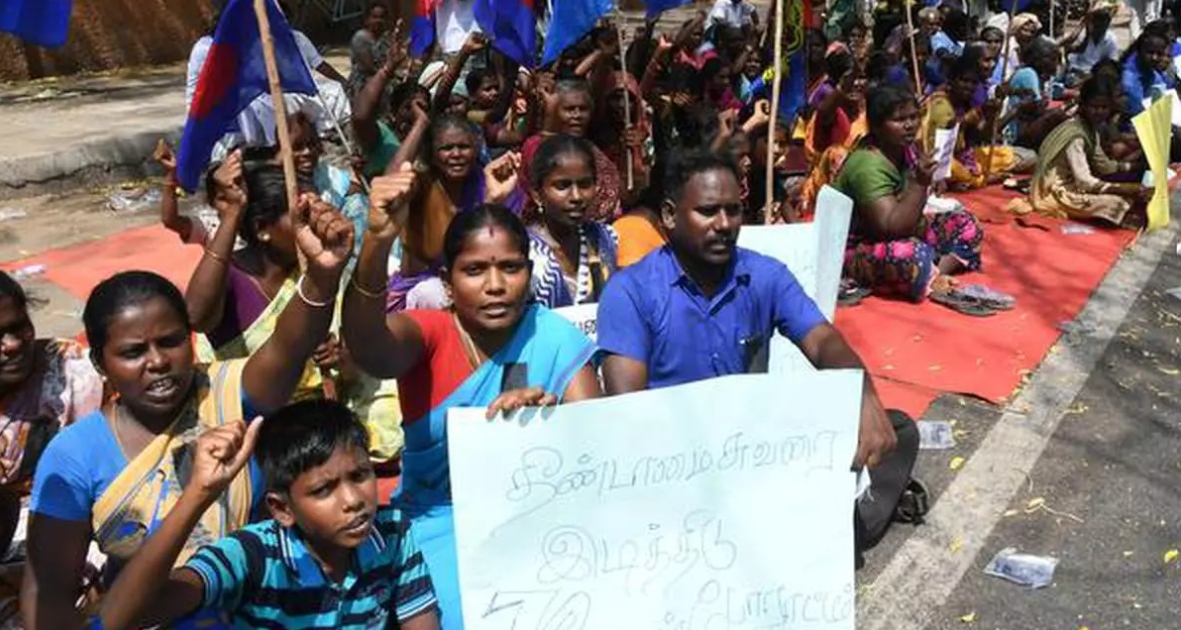
Supreme Court upholds reservation for Arunthathiyars in Tamil Nadu, and State governments’ authority to provide reservations within SC category
- Source Of Info
- Frontline
- Date Of Fr
- 2020-08-28