- Message
- show
Jaldi-Vidhi
All India Judges Association v. Union of India
Case details and hearing information from the Constitution Bench Pendency Portal.
613
All India Judges Association v. Union of India
This case concerns long-standing problems in career progression in the Higher Judicial Services (HJS), focusing on seniority criteria, recruitment pathways, quota systems and roster structur.
- Petitioners Arguments
- The present system of appointment to the Higher Judicial Services results in an age advantage for the Direct Recruits over those who enter the service through the Regular Promotion (RP) and Limited Departmental Competitive Examination (LDCE) routes, thereby making it easier for the former to get elevated to higher positions. Experience in judicial service is superior to experience in the Bar, and therefore, prior service in the Civil Judge Junior/Senior Division should be recognised for promotions to the HJS irrespective of the cadre. Earlier directions in the AIJA proceedings and state-specific rules have led to artificial “sub-classes” within the District Judge cadre, contrary to Articles 14 and 16 , and a single, unified cadre with a transparent roster and seniority system is constitutionally mandated. The Court should, in exercise of its powers under Articles 32 , 141 , and 142 , lay down a country-wide standard, particularly a rational roster and common seniority criteria, to ensure equality of opportunity while respecting the role of High Courts under Articles 233 - 235.
- Responders Arguments
- Service rules for the Higher Judicial Service primarily fall within the domain of State legislatures and High Courts’ control under Articles 233-235, and over-standardisation ignores local concerns and existing statutory systems. The three-source system (RP, LDCE, DR) and the existing roster models were designed to take into account experience, internal advancement, and infusion of external talent, and that any redesign must preserve this balance without retrospectively unsettling time-tested seniority and promotion norms. Even if a uniform roster is introduced, past service in the lower judiciary should not carry “bonus” seniority within HJS; once officers enter the Higher Judicial Service, their source of recruitment and earlier service should not operate as a permanent “birthmark” that entitles them to preferential treatment over others in the common cadre.
- Last Listed On
- 2025-11-19
- Start Date
- 1989-09-15
- End Date
- 2025-11-19
- Review Petition No
- W.P. (C) No. 1022/1989
- Case Status
- Archive
- Bench Status
- Constituted
- Subject Matter
- Judicial Reform
- Disposal Time
- 1 month 12 days
5 Judge Bench
Judgment delivered
- Consider As Stage Of Pendency
- false
Date of institution of case
Date of reference to 5 Judge Bench
Judgement pronounced
The All India Judges Association case has been kept active by the Supreme Court since its inception in 1989, using the tool of continuing mandamus, in order to periodically issue directions aimed at judicial reform. The present matter arose from an interlocutory application in the case filed by amicus curiae Senior Advocate Siddharth Bhatnagar, highlighting problems in seniority and promotion in the judiciary. The Higher Judicial Service (HJS) is composed of Regular Promotees (RPs), Limited Departmental Competitive Examinations (LDCE) Promotees, and Direct Recruits (DRs), forming the senior cadre of judges eligible for higher posts and promotion to the High Court. The amicus curiae flagged issues relating to inter-se seniority amongst these categories. The issue of disparities in progression within the HJS has been commented upon many times in previous AIJA proceedings and also noted by the First National Judicial Pay Commission (also known as the Shetty Commission). The application presented the following four recommendations before the court to choose from: i. Selection Grade and Super Time Scale appointments to the District Judge position should have a 1:1 quota of DRs and promotees. ii. The pool for appointment to the aforementioned grades must consist of 50% of DRs and 50% of promotees. iii. Providing one year of seniority for every five years of service, for a maximum of three years, prior to elevation to the HJS. iv. HJS to have three seniority lists based on recruitment source in a 50:25:25 ratio.
To what extent can the Supreme Court intervene in laying down guidelines governing the structure and functioning of the judicial services, vis-a-vis the power of the High Courts to do so under Articles 233 - 235 ? Does the existing system of appointment to the higher judicial services favour Direct Recruits (DRs) over promotee judges? Should the period of judicial service of the promotees prior to their incorporation into the District Judge cadre, be considered in determining seniority? Does the roster system in promotion to the Higher Judicial Services warrant revision to introduce more uniformity and address gaps in seniority?
Article 233 of the Constitution of India
Article 234 of the Constitution of India
Article 235 of the Constitution of India
Aiming to resolve long-standing disparities in inter-se seniority between the different District Judge cadres, the Court recognised the necessity of balancing competing claims and reconsidering earlier judgments and orders passed by three-judge Bench judgments and in order to provide a “meaningful and long-lasting solution”, referred the matter to a five-judge bench.
NA
State of Maharashtra v. Parasmal Pukhraj Bafna
- Date Of Institution Start
- 2022-05-05
- Date Of Tagging
- 2020-01-27
- Case No
- SLP(C) No. 8536 / 2022
- Date Of Tagging Link
- https://api.sci.gov.in/supremecourt/2020/2656/2656_2020_1_28_19901_Order_27-Jan-2020.pdf
Lokesh Kumar v. The State of Uttar Pradesh
- Date Of Institution Start
- 2024-05-04
- Date Of Tagging
- 2025-01-23
- Case No
- W.P.(C) No. 301 / 2024
- Date Of Tagging Link
- https://api.sci.gov.in/supremecourt/2024/19945/19945_2024_2_17_58745_Order_23-Jan-2025.pdf
Performance Evaluation and Promotion Schemes of Judicial Officers in India - A Comparative Report

- Source Of Info
- Department of Justice
- Date Of Fr
- 30-06-2026
All India Judicial Services: Problems and Prospects

- Source Of Info
- NUJS Law Review
Reservation for Civil Judges in Principal District Judge Posts | Judgement Summary
- Source Of Info
- Supreme Court Observer (SCO)
- Date Of Fr
- 2025-11-19
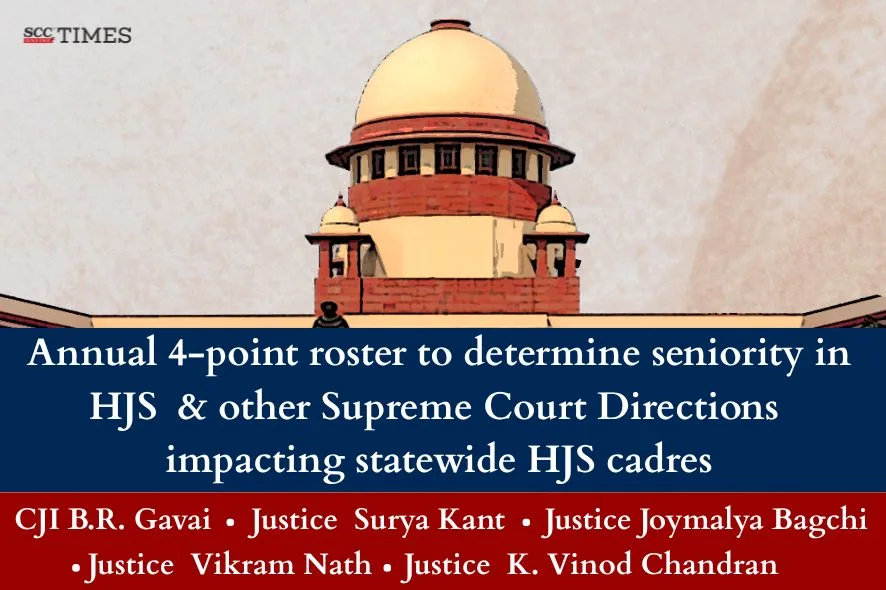
Annual 4-point roster to determine seniority in HJS; This & other Supreme Court Directions impacting statewide HJS cadres
- Source Of Info
- SCC Online
- Date Of Fr
- 2025-11-19