Maratha Muslim Aarakshan Kruti Samiti v. The Chief Minister of State of Maharashtra
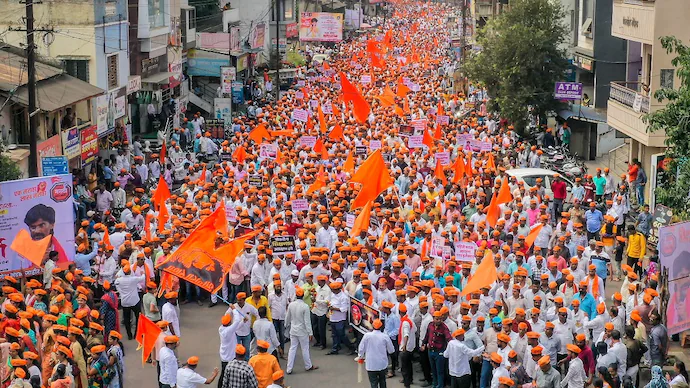
This case is a review petition filed in the case of Jaishri Laxmanrao Patil v. Chief Minister of Maharashtra, which dealt with the legality of reservations in public employment and education for the Maratha community in Maharashtra.
Petitioners Arguments
Applicant's arguments are not available since no order has been passed in the case.
Responders Arguments
Respondent's arguments are not available since no order has been passed in the case.
Start Date
2024-01-25
Card Stage Date
2024-01-25
Review Petition No
Diary Number- 3955/2024
Case Status
Pending
Bench Status
Not Constituted
Subject Matter
Constitution
Pendency
2 years, 5 months, 5 days
5 Judge Bench
Miscellaneous
Consider As Stage Of Pendency
true
Date of institution of case
This case is a review petition filed on the judgment in Jaishri Laxmanrao Patil v. Chief Minister of Maharashtra , which dealt with the legality of reservations in public employment and education for the Maratha community in Maharashtra. The Maharashtra government, in 2014, issued an ordinance granting 16% reservation to Marathas and 5% to Muslims in education and public employment, which was challenged in the Bombay High Court. The Bombay High Court stayed the 2014 ordinance, leading to the enactment of the Socially and Educationally Backward Classes (SEBC) Act, 2018 , which provided 16% reservation for Marathas. In June 2019, the Bombay High Court upheld the SEBC Act’s constitutionality but recommended reducing Maratha reservations to 12-13% as per the Gaikwad Commission’s findings . The Supreme Court in 2020 in the Jaishri Laxmanrao Patil case struck down the SEBC Act, ruling it unconstitutional for exceeding the 50% reservation ceiling without showing "extraordinary circumstances." Currently, the Maratha community lacks a separate reservation under the SEBC Act, and the Maharashtra government is exploring legal alternatives to address their concerns within constitutional limits. Since, this is a review petition in a 5-judge bench case, it will be placed before a Constitution Bench.
Questions of law have not been formulated yet.
NA
Since a 5- judge bench gave the decision in the Jaishri Laxmanrao Patil case, this review petition will be placed before a 5-judge bench.
Jaishri Laxmanrao Patil v. Chief Minister of Maharashtra
Maratha Reservation
Source Of Info
Supreme Court Observer
Date Of Fr
2024-01-24
The Case of the Maratha Reservations: Jaishri Laxmanrao Patil v. Chief Minister of State of Maharashtra
Source Of Info
Constitutional Law Society
N.G. Jayasimha v. Union of India
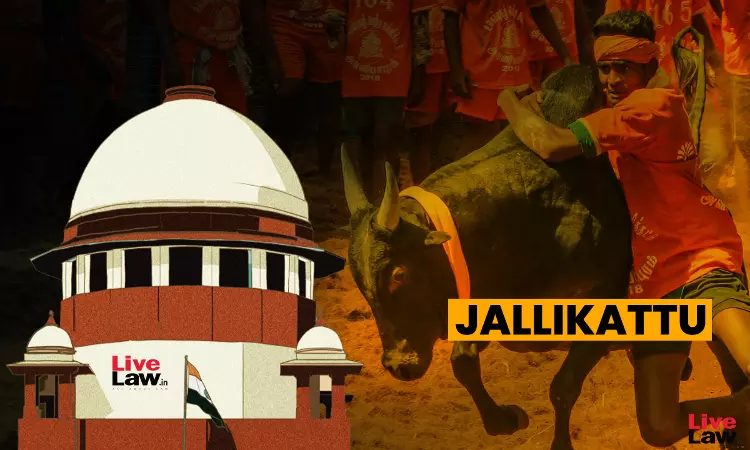
This is a review petition in the case of Animal Welfare Board of India v. Union of India, which upheld the legality of the traditional sport of Jallikattu in Tamil Nadu.
Petitioners Arguments
The Constitution Bench failed to appreciate that, in A. Nagaraja , Jallikattu and other similar "bovine sports" were held to amount to animal cruelty per se. Although after the judgment, the Tamil Nadu government passed an amendment to the Prevention of Cruelty to Animals Act, 1960 , which modified the way in which Jallikattu took place, the same did not do away with the inherent cruelty that prevails in Jallikattu. The state amendments and the Rules lack legislative competence since they explicitly seek to exempt Jalikattu from the provisions of the 1960 Act, in direct contravention of the Act’s underlying intent of preventing cruelty against animals. Animals may not have rights equivalent to human beings under Article 21 of the Constitution, but they have a core threshold of rights, including the right to live with dignity, the right to be free from unnecessary suffering, and the right against torture.
Responders Arguments
The respondents have not put forth their arguments.
Start Date
2023-07-03
Card Stage Date
2025-07-31
Review Petition No
R.P.(C) No. 892/2023
Case Status
Pending
Bench Status
Not Constituted
Subject Matter
Civil Law
Pendency
2 years, 11 months, 10 days
This case is a review petition filed on the judgement in Animal Welfare Board of India v. Union of India , which upheld the legality of the traditional sport of Jallikattu in Tamil Nadu. In 2006, the Madras High Court banned the sport , stating that it was in violation of the Prevention of Cruelty to Animals Act, 1960 . In 2009, the Tamil Nadu government passed the Tamil Nadu Regulation of Jallikattu Act 2009 , which, while permitting the conduct of the sport, issued guidelines that organisers of Jallikattu had to adhere to. In 2011, the Ministry of Environment and Forests, through a notification added bulls to its list of animals that could not be trained or exhibited as performing animals. In 2014, the Supreme Court, in Animal Welfare Board of India v. A. Nagaraja [(2014) 7 SCC 547] banned Jallikattu and struck down the Tamil Nadu Regulation, 2009 on the ground that it was repugnant to the provisions of 1960 Act (and therefore violative of Art. 254(1) ). In 2017, the Prevention of Cruelty to Animals (Tamil Nadu Amendment) Act, 2017 was passed, which effectively exempted the application of the Prevention of Cruelty to Animals Act to Jallikattu. The petitioners challenged this Act as well, and the Supreme Court after hearing the matter, felt that there were substantial questions relating to the interpretation of the Constitution and referred the matter to a Constitution Bench. On 18th May 2023, the Constitution Bench upheld the sport of Jallikattu in its judgment. It held that Jallikattu is a cultural practice and does not violate the provisions of the 1960 Act. Since a 5- judge bench gave the decision in the Animal Welfare Board case, this review petition will be placed before a 5-judge bench.
Are “ bovine sports ” inherently cruel, as held in the A. Nagaraja judgment? Do the Tamil Nadu amendment and the Rules lack legislative competence for violating the intent of the Prevention of Cruelty to Animals Act, 1960 ? Do animals have a core threshold of rights, including the right to live with dignity, the right to be free from unnecessary suffering, and the right against torture?
Prevention of Cruelty to Animals (Tamil Nadu Amendment) Act, 2017
The court has not pronounced any order in the case.
Animal Welfare Board of India v. Union of India [2023 SCC OnLine SC 661]
The Animal Welfare Board of India v. Union of India
Date Of Institution Start
2023-07-03
Date Of Tagging
2024-07-09
Case No
Diary No. 26252/2023
Federation of Indian Animal Protection Organizations (FIAPO) v. Union 0f India
Date Of Institution Start
2023-07-14
Case No
Diary No. 27842/2023
Federation of India Animal Protection Organizations v. Union of India
Date Of Institution Start
2023-07-14
Case No
Diary No. 27799/2023
People for Ethical Treatment of Animals (PETA) v. The State of Tamil Nadu
Date Of Institution Start
2023-07-15
Case No
R.P.(C) No. 810-812/2023
Compassion Unlimited Plus Action v. Union of India
Date Of Institution Start
2023-08-08
Case No
R.P.(C) No. 1109/2023
The Animal Welfare Board of India v. Union of India
Date Of Institution Start
2025-05-15
Case No
R.P.(C) No. 1072/2025
Anjali Sharma v. Union of India
Date Of Institution Start
2025-07-31
Case No
R.P.(C) No. 1697/2025
Review Sought Of SC Judgment Which Upheld Laws Allowing Jallikattu, Kambala & Bullock Cart Racing
Source Of Info
Livelaw
Date Of Fr
2024-07-10
A critical analysis of the Animal Welfare Board of India v Union of India (Jallikattu II case): Evolution of animal rights jurisprudence in India
Source Of Info
Springer
Date Of Fr
2024-07-10
Supreme Court Constitution Bench holds Jallikattu, Kambala and bull -cart racing legal
Source Of Info
SCC Times
Date Of Fr
2023-05-18
Judgement Matrix : Challenge to Jallikattu
Source Of Info
Supreme Court Observer
Date Of Fr
2023-05-18
Anjuman Ishaat-e-Taleem Trust v. The State of Maharashtra
This case seeks to re-examine the 2014 ruling of the Supreme Court in Pramati Educational and Cultural Trust v. Union of India that excluded Minority Educational Institutions from the purview of the Right to Education Act, 2001.
Petitioners Arguments
Strict TET requirement amid low pass rates and rising teacher demand will lead to shortage of teachers which will undermine the objectives of the Right to Education (RTE) Act. TET is not a ‘minimum qualification’ under Section 23 of the RTE Act , but it is merely an eligibility test to assess teaching aptitude. Law made in exercise of the mandate of Article 21A should not abrogate the rights of minority educational institutions under Article 30(1) of the Constitution. The valid and invalid provisions of the RTE Act are inseparable and, thus, the entire RTE Act cannot apply to minorities and if, at all, the issue is referred to a larger Bench, the same has to be restricted to the applicability of Section 23 of the RTE Act. The Constitution Bench in Pramati upheld the exemption granted to minorities under Article 15(5) , to protect the minority character of the institutions, and to prevent the majority from making a law imposing the general gamut of laws on minority institutions. This is backed by precedent in Society for Unaided Private Schools of Rajasthan v. Union of India . Imposing TET qualification for promotion may cause hierarchical stagnation, which could not have been the intention of the Parliament. Retrospectively revoking benefits acquired under existing rules would violate Articles 14 and 16 of the Constitution.
Responders Arguments
The right to be taught by qualified teachers cannot be limited or impeded, except to the limited extent provided for under Article 29 or Article 30 of the Constitution. To exempt a particular category of institutions would be contrary to Article 21A of the Constitution of India and create an artificial distinction. A composite reading of Section 23 of the RTE Act reveals TET is a mandatory and an indispensable qualification/eligibility criterion to ensure the maintenance of quality education, irrespective of their classification as minority/majority or aided/un-aided institutions. Judgment of a larger Bench of this Court can be explained by a smaller bench. Similarly, the judgment in Pramati , in particular paragraph 55, can be adequately explained in the present case by providing a context to the RTE Act with the National Council for Teacher Education (NCTE) scheme. Only in the event that this exercise cannot be undertaken, the question of reference to a larger Bench may arise. Paragraph 55 of Pramati is merely obiter dicta and will not lead to a conclusion insofar as applicability/eligibility criteria for appointment of teachers is concerned. Applicability of the RTE Act to minority institutions was incidental to the main issue and not essential to the decision. In Pramati, this Court was never called upon to decide the constitutional validity of the entire RTE Act or even Section 23 thereof. The Court was restricted to the validity of the Constitution (Ninety-third) Amendment Act, 2005 and Constitution (Eighty-sixth) Amendment Act, 2002 . It cannot be said that the Constitution Bench in Pramati was seized of the question as to whether the entire RTE Act was unconstitutional.
Last Listed On
2026-02-24
Start Date
2025-02-03
Review Petition No
C.A. No. 1385/2025
Case Status
Pending
Bench Status
Not Constituted
Subject Matter
Constitution
Pendency
9 months, 29 days
Reference to larger bench
Consider As Stage Of Pendency
true
Date of reference to 5 Judge Bench
The case arose from a bunch of petitions challenging judgments and orders passed by the Bombay and Madras High Courts, all of which involved the issue of qualification in the Teacher Eligibility Test (TET) as a mandatory condition for appointment and promotion in teacher posts in educational institutions. The appeals also included aggrieved Minority Educational Institutions (MEIs) like those run by the Anjuman Ishaat-e-Taleem Trust which relied on the 2014 Constitution Bench ruling in Pramati Educational and Cultural Trust v. Union of India , which had held that the Right to Education (RTE) Act (under Section 23 of which the TET was notified) did not apply to either aided or unaided MEIs. In Pramati, the validity of the 93rd Constitutional Amendment which added clause (5) in Article 15 of the Constitution, and the 86th Constitutional Amendment which inserted Article 21-A , providing for the right to education as a fundamental right, was up for challenge before the Supreme Court. The Court upheld the validity of Article 21-A, and by extension, the RTE Act, but carved out an exception for MEIs. Striking a balance between the right to education under Article 21A and minority rights under Article 30(1) , it held that the minority character of MEIs would be affected if they were made to comply with provisions of the RTE Act that would require them to provide reservations to students not belonging to the minority community.
Can the TET examination be mandated as a criterion for becoming a teacher of an MEI and whether providing such a qualification would affect the fundamental rights of MEIs? Does Article 30(1) envisage blanket immunity to MEIs from all forms of regulation such as those flowing from Article 21A ? Can the RTE Act function as a reasonable restriction under Article 19(6) on the exercise of the right to occupation of teachers under Article 19(1)(g) ? How far does Article 141 permit the Supreme Court to re-examine legal principles laid down in its previous judgments? Does excluding MEIs from the scope of the RTE Act threaten the principles of universal access to elementary education and common schooling that are fundamental to Article 21A?
The Right of Children to Free and Compulsory Education Act, 2009
Article 21A of the Constitution of India
Article 30 of the Constitution of India
Article 141 of the Constitution of India
Observing that exempting minority schools from the ambit of the RTE Act may undermine universal access to basic education guaranteed under Article 21A , The two-judge bench expressed “serious doubt” over whether the blanket exemption outlined in Pramati was correctly decided, and referred the matter to the CJI for consideration of the issue by a larger bench.
Pramati Educational and Cultural Trust v. Union of India AIR 2014 SC 2114
Municipal Corporation of Greater Mumbai v. Patel Sadiya Abdul Lateef
Date Of Institution Start
2025-02-01
Case No
C.A. Nos. 1364–1367 / 2025
The Association of Urdu Education Societies v. The State of Maharashtra
Supreme Court Doubts Correctness Of Judgment Exempting Minority Schools From RTE Act; Refers To CJI
Source Of Info
LiveLaw
Date Of Fr
2025-09-01
Teacher’s Eligibility Test required to continue in service; applicability on minority institutions to be examined by larger Bench: Supreme Court
Source Of Info
Bar & Bench
Date Of Fr
2025-09-01
Tamil Nadu Cements Corporation v. Micro and Small Enterprises Facilitation Council
This case deals with the maintainability of writ petition against an order or award of the Micro and Small Enterprises Facilitation Council.
Petitioners Arguments
As the proceedings before the Constitution Bench have not commenced, the appellants have not put forth their arguments yet.
Responders Arguments
As the proceedings before the Constitution Bench have not commenced, the respondents have not put forth their arguments yet.
Last Listed On
2025-08-25
Start Date
2025-01-22
Review Petition No
C.A. No. 1016/2025
Case Status
Pending
Bench Status
Not Constituted
Subject Matter
Arbitration
Pendency
1 year, 5 months, 8 days
The appeal arose from a dispute under the Micro, Small, and Medium Enterprises Development Act, 2006 (MSMED Act) concerning a contract between Tamil Nadu Cements Corporation Limited (TANCEM), a government-owned entity, and M/s Unicon Engineers for installing Electrostatic Precipitators (ESPs). TANCEM withheld payments, citing substandard work and delays, prompting Unicon Engineers to invoke conciliation proceedings under Section 18 of the MSMED Act. After conciliation failed, the Micro and Small Enterprises Facilitation Council (MSEFC) allowed the Company to proceed with arbitration. TANCEM’s challenges to the MSEFC’s decision were dismissed at various stages, prompting them to file the present appeal.
Can a writ petition be maintainable against an order or award of the MSEFC, considering the availability of alternative remedy under Section 34 of the Arbitration and Conciliation Act, 1996? What are the exceptions to the restrictions of the principle of adequate alternative remedy? Upon failure of conciliation proceedings, can the MSEFC itself act as arbitrators of the arbitral tribunal in terms of Section 18 of the MSMED Act read with Section 80 of the Arbitration Act?
Sections 34 and 80 of the Arbitration and Conciliation Act, 1996
The court referred the matter to a 5-judge bench for authoritative pronouncement in light of conflicting precedents.
Jharkhand Urja Vikas Nigam Limited v. State of Rajasthan
Gujarat State Civil Supplies Corporation Limited v. Mahakali Foods Private Limited
M/S Tamil Nadu Medicinal Plant Farms v.Union of India
Maintainability Of Writ Petition Against Orders Passed By Micro & Small Enterprises Facilitation Council U/S 18 MSMED Act: Supreme Court Refers Issue To Larger Bench
Source Of Info
Verdictum
Date Of Fr
2025-01-22
SC refers key issues on writ jurisdiction under MSMED Act to larger bench
Source Of Info
The Print
Date Of Fr
2025-01-22
Hariharan v. Harsh Vardhan Singh Rao
This case concerns a dispute between promotees and direct appointees vis-a-vis inter-se seniority for the posts of Inspectors in the Income Tax Department of Gujarat.
Petitioners Arguments
As per K. Meghachandra Singh. v. Ningam Siro the seniority of direct recruits will be reckoned only from the date of recruitment and not from the date when the requisition for their appointment was sent. Union of India v. N.R.Parmar on which the respondents are relying has been overruled by K. Meghachandra . When there was no advertisement and no requisition issued for the vacancies of the year 2009, the vacancies of the year 2009 were combined with the vacancies in 2010. Therefore, relative merit of selected candidates cannot be determined for assigning the seniority in different recruitment years, the reason being that there was only one merit list for the 2010 examination.
Responders Arguments
The decision of K. Meghachandra Singh is per incuriam because it disregards the court’s decision in Mervyn Coutindo v. Collector of Customs, Bombay which upholds the present rotational system of promotion. Even the decision in the case of K. Meghachandra protects the case of the respondents as it operates prospectively and hence will not apply to the seniority list which was issued prior to the pronouncement of judgement in the case.
Last Listed On
2025-04-15
Start Date
2022-12-14
Card Stage Date
2022-12-14
Review Petition No
SLP(C) No. 16161/2018
Case Status
Pending
Bench Status
Not Constituted
Subject Matter
Administrative Law
Pendency
3 years, 6 months, 16 days
Date of reference to larger Bench
This case concerns a dispute between promotees and direct appointees vis-a-vis inter-se seniority for the posts of Inspectors in the Income Tax Department of Gujarat. Office Memoranda issued by the Ministry of Personnel, Public Grievances and Pension in 1986 read with the Recruitment Rules of 1969 provides that the promotees and the direct recruits could be promoted together in a 2:1 ratio. However, a clarificatory Office Memoranda issued by the Department of Personnel and Training stated that seniority will be based on the year of appointment and not on the year in which the vacancy arose. On 13-02-2018, a seniority list was published that placed direct recruits for the year 2009-10 with the promotees of the year 2010-11. This meant that their promotion would be held off by one year in comparison to the department promotees of the year 2009-10. The Respondents in this case, who were direct recruits, filed a writ petition before the High Court of Gujarat for quashing the said seniority list and the High Court issued an order in their avour. Leave was granted to appeal against the High Court’s decision
Should the promotion of direct recruits be based on the year in which the vacancy arose or the year in which the actual recruitment took place?
Due to the differing precedents on the matter, and the differences in the Bench sizes therein, the two-judge bench referred the matter to a Constitution Bench.
Union of India v. N.R.Parmar
K. Meghachandra Singh v. Ningam Siro
Mervyn Coutindo v. Collector of Customs, Bombay
Harsh Vardhan Singh Rao v. Union Of India Through Secretary
Inter-se-seniority -Promotees versus Direct Appointees: ‘K. Meghachandra requires reconsideration’; Supreme Court’s 5-judge bench to hear the matter
Source Of Info
SCC Online
Date Of Fr
2022-12-24
Dispute Between Promotees, Direct Appointees Over Inter-Se Seniority: SC Refers Matter To Constitution Bench
Source Of Info
Verdictum
Date Of Fr
2022-12-16
Date Of Joining Irrelevant In Fixing Seniority Of Direct Recruits
Source Of Info
Bhatt and Joshi Associates
Tej Bhan v. Ram Kishan
This case will clarify whether a woman’s right to a property can be limited/restricted under S.14 of the Hindu Succession Act, 1956.
Petitioners Arguments
V. Tulsamma and other cases have clearly established a woman’s absolute right over property given to her, irrespective of the stipulations in the Will or other transfer instruments. The widow, therefore, had an absolute right to sell the property to the appellant, making the sale valid.
Responders Arguments
Karmi v. Amru (1971) (same ratio as Sadhu Singh) is valid, as it was decided by a three judge bench of the Supreme Court and had not been overruled. The same was also relied on along with Sadhu Singh and a series of similar judgements by the Punjab and Haryana High Court while pronouncing its verdict in the impugned matter.
Last Listed On
2025-02-12
Card Stage Date
2025-02-12
Review Petition No
C.A. No. 6557/2022
Case Status
Pending
Bench Status
To be reconstituted
Subject Matter
Family Law
Pendency
1 year, 6 months, 21 days
Awaiting bench reconstitution
Consider As Stage Of Pendency
true
The Appellant bought property from a widow, who had a life interest in it, limited to the extent of her maintenance with an explicit bar on sale or mortgage. After her death, the property was to revert to her son and his grandchildren, who filed a suit to declare the sale as invalid. Under Section 14(1) in The Hindu Succession Act, 1956 a Hindu woman has absolute ownership over property acquired by her. However, Section 14(2) of the 1956 Act makes an exception for properties acquired as gift or under a Will etc. If the will or deed imposes a limit, then the woman will not have absolute ownership of the property. In Seth Badri Prasad v. Smt. Kanso Devi (1969) and in V. Tulasamma v. Sesha Reddy (1977), the Supreme Court held that Section 14(1) should be liberally read in furtherance of socio-economic objects of the Hindu Succession Act and that women should have full ownership of property, regardless of the terms of the will or transfer instrument. In Sadhu Singh v. Gurdwara Sahib Narike , however, the Court said if the transfer instrument provided a limited interest, then the woman could not claim absolute ownership and cannot sell, mortgage or dispose of the property. Multiple successive two and three judge SC benches either accepted or rejected Tulsamma and Sadhu Singh , differing from each other on a case to case basis. The present matter has been referred to the Constitution Bench to interpret the relationship between Sections 14(1) and 14(2) of the Act, and resolve the conflict between coordinate bench judgments.
Whether a woman enjoys absolute ownership rights under S. 14 of the Hindu Succession Act, 1956 on properties received as a part of maintenance, partition, inheritance etc.?
Section 14(1) and (2) of the Hindu Succession Act, 1956
In light of conflicting judgments by coordinate benches, the Court referred the matter to a larger bench for an authoritative pronouncement.
Hindu Succession Act | Life Interest Given To Woman Will Not Transform Into Absolute Ownership As Per Section 14 : Supreme Court
Source Of Info
Livelaw
Date Of Fr
2024-12-21
State of West Bengal v. Paschim Banga BK Samity
This case deals with the constitutional validity of the West Bengal Land Reforms Act, 1955
Petitioners Arguments
Only a part of Article 14 has been held to be part of the basic structure of the constitution and therefore Article 300A need not conform to all facets of Article 14 (relying on T.M.A. Pai Foundation v. State Of Karnataka [(2002) 8 SCC 481] ) . Unlike Article 31(2), Article 300A does not contemplate compensation for depriving a person of his property and therefore a citizen does not have the right to claim compensation or question the inadequacy of the same. The doctrine of eminent domain did not apply to a country with a written constitution. An Act will get protection under Article 31A if its dominant purpose is agrarian reform, even if it includes within its ambit, non-agricultural lands. Agrarian reform is wider than land reform and the Act envisioned the creation of a new social order and an increase in employment opportunities, which were different facets of agrarian reform ( Sasanka Sekhar Maiti v. Union of India (1980) 4 SCC 716 ) A large and liberal meaning was to be given to expressions like ‘estate’ and ‘rights in an estate’. Acquisition of private property gets protection under Article 31C as private property comes within the definition of ‘material resources of the community’ and the redistribution thereof to provide access to equal opportunities and subserve common good gives effect to Article 39(b) ( Sanjeev Coke Mfg. Co. v. Bharat Coking Coal Ltd. (1983) 1 SCC 147 ).
Responders Arguments
The judgment in Jillubhai Nanbhai Khachar v. State of Gujarat [1995 Supp. (1) SCC 596] , which was pronounced post the enactment of Article 300A states that acquisition of property by the state and payment of compensation were part of the scheme (of eminent domain) and they could not be dissected. Article 14 applies to land acquired under Article 300A insofar as compensation paid for acquisition of unequal types of land (farms, factories, buildings) cannot be equal and a blanket rate/area cannot be charged on all lands. Article 31C provides immunity against challenges on grounds of Article 14 and 19 but not against challenges on the grounds of violation of Article 300A. An Act will not be saved by Article 31A if it does not advance the object of Article 31A, i.e Agrarian Reform. By extension, the law is not saved by Article 31A insofar as the provisions which legislate on non-agricultural tenancies, factories, etc, and corresponding definitions of ‘land’ that include non-agricultural tenancies, factories, etc. The 1981 and 1986 Amending Acts (and the Constitutional amendments inserting them into the Ninth schedule) are violative of the basic structure of the Constitution and are therefore not protected under Article 31B.
Last Listed On
2024-09-11
Card Stage Date
2014-07-17
Review Petition No
C.A. No.16879/1996
Case Status
Pending
Bench Status
To be reconstituted
Subject Matter
Constitution
Pendency
11 years, 11 months, 13 days
In 1955, The West Bengal Land Reforms Act was enacted by the State to consolidate laws relating to land reforms. However, it did not have the desired impact due to various exemptions such as the ceiling limit on the land that could be held by a person applied only to agricultural lands, which led to large-scale conversions of agricultural land into non-agricultural land like orchards. The West Bengal Land Reforms (Amendment) Act 1981 (and the subsequent (Amendment) Act 1986) enacted several changes to plug these loopholes including removing the distinction between agricultural and non-agricultural lands. Several writ petitions were filed in the High Court questioning the constitutionality of the Act. The State argued that the Act was protected under i) Article 31A as the law provided for ‘acquisition of land rights’ in furtherance of the object of Article 31A (agrarian reform) ii) Article 31B as the principal Act and the amending Acts were included in the Ninth Schedule) and iii) Article 39(b) and (c) . A Division Bench of the High Court, while ruling that the Act was protected under Article 31A, 31B, 31C in its judgment held that the aforementioned Sections 2(7), 3A, and 14V of the West Bengal Act were ultra vires of Article 300A . On appeal, both the two-judge and the three-judge bench of the Supreme Court felt that the matter involved substantial issues of constitutional interpretation with respect to the scope of Article 300A and its interplay with Article 31A, 31B, and 31C among other things, and therefore referred the case to a Constitution Bench.
What is the scope and content of Article 300A? In particular, whether a law contemplated therein has to conform to Article 14 and/or any facet of Article 14 of the Constitution? What is the extent of protection available in respect of law which is challenged under Article 300A in the context of Articles 31A, 31B and 31C of the Constitution? Is the protection of Article 31A available when the scope of agrarian reform law is altered by amendment of the meaning of expressions "estate", "rights", "proprietor", sub-proprietor", "tenure holder", "raiyat and under raiyat" and "other intermediaries" (contrary to their meaning in 31A(2) of the Constitution) thereby covering non-agricultural lands including factories and mills? Does Article 300A allow for payment of any amount as compensation for depriving a person of his property under the authority of law? If yes, then what are the parameters of adjudging the principles for payment of the amount or the amount fixed by the Acquiring Act as illusory? Are the Constitutional Amendments inserting the amending Acts in the IXth Schedule violative of the Basic Structure of the Constitution and would therefore be open to challenge in the light of the judgment of the Supreme Court in I.R. Coelho v. State of Tamil Nadu [(2007) 2 SCC 1] and therefore liable to be struck down? Is Section 4-D inserted by the 1981 Amendment Act of the West Bengal Land Reforms Act, 1955, which prescribes the offences and penalties with retrospective effect from 07-08-1969, in the face of the prohibition contained in Article 20(1) of the Constitution of India, valid?
West Bengal Land Reforms Act, 1955
The West Bengal Land Reforms (Amendment) Act 1981
The Supreme Court felt that there were substantial questions of law that required interpretation of the Constitution in the present case, and referred the matter to the Constitution Bench.
State of W.B. v. Paschim Banga Rajya Bhumijibi Sangha
Date Of Institution Start
1997-01-20
Case No
C.A. No. 334/1997
State of W.B v. Umananda Roy(D) by LRS.
Date Of Institution Start
1997-01-20
Case No
C.A. No. 335/1997
Paschim Banga Rajya Bhumijibi Sangha v. State of W.B
Date Of Institution Start
1997-01-20
Case No
SLP(C) No. 1416/1997
State of W.B v. Tapas Kundu
Date Of Institution Start
1997-01-27
Case No
C.A. No. 509/1997
State of W.B v. Paschim Banga B.K. Samity
Date Of Institution Start
1997-01-27
Case No
C.A. No. 510/1997
Revenue Officer v. SK Abdul Hai
Date Of Institution Start
1997-02-10
Case No
C.A. No. 775/1997
The State of W.B And Others v. Tarapada Das Palit(Dead) by LRS.
Date Of Institution Start
1997-02-10
Case No
C.A. No. 776/1997
The State of W.B v. Md. Ahad Box
Date Of Institution Start
1997-03-03
Case No
C.A. No. 1789/1997
The State of W.B and Ors. v. Panchanan Roy and Ors.
Date Of Institution Start
1997-03-03
Case No
C.A. No. 1790/1997
The State of W.B and Ors. v. Krishna Gayen
Date Of Institution Start
1997-03-21
Case No
C.A. No. 2453/1997
The State of W.B v. Sri Ananta Purusottam Jew Thankur
Date Of Institution Start
1997-03-21
Case No
C.A. No. 2450/1997
State of W.B v. Harisadhan Bandopadhyay
Date Of Institution Start
1998-03-20
Case No
C.A. No. 1719/1998
The State of W.B and Ors. v. Sefali Mondal and Ors.
Depeasantization Discontinued: Land Reforms in West Bengal
Source Of Info
JSTOR
Determinants of Redistributive Politics: An Empirical Analysis of Land Reforms in West
Source Of Info
EML Berkeley
Date Of Fr
2008-09-15
Belling the Cat: The Curious Case of the Ninth Schedule
Source Of Info
JSTOR
The State of Kerala v. Union of India
This case will decide whether the Union can impose a borrowing limit on states.
Petitioners Arguments
Under Article 293 of the Constitution, the Union of India does not have the power to regulate all the borrowings of a State and conditions can be imposed only on the loans sought from the Central Government. The liabilities arising out of the Public Account and State-Owned Enterprises cannot be included in the borrowings of the Plaintiff. The plaintiff is in dire need of INR 26,226 crores to pay dues arising out of various budgetary obligations including dearness allowance, pension scheme, subsidies, etc. There has been an underutilization of permissible borrowing space from previous years, which the plaintiff should be allowed to use. The over-borrowing from the years before F.Y 2023-24 cannot be adjusted from the Net Borrowing Ceiling of this F.Y and must instead be repaid at the date of maturity of such borrowing.
Responders Arguments
Since management of public finance is a national issue, the Union of India has the power to regulate all the borrowings of the plaintiff to maintain the fiscal health of the country. The liabilities arising out of the Public Account and State- Owned enterprises can be included in the borrowings of the plaintiff since they may be used to by-pass the borrowing ceiling. The pending dues have arisen on account of the fiscal mismanagement by the state of kerala and are not a consequence of regulation of borrowing by the Union of India. The Plaintiffs contention regarding the under-utilized borrowing space from the previous years is based on erroneous facts. The over-borrowing done in a F.Y has to be adjusted against the borrowing amount of the next F.Ys. The fiscal health of the country will be jeopardized if the plaintiff is allowed to undertake more debt.
Last Listed On
2024-04-01
Start Date
2024-04-01
Card Stage Date
2024-04-01
Review Petition No
Original Suit 1/2024
Case Status
Pending
Bench Status
Not Constituted
Subject Matter
Constitution
Pendency
2 years, 2 months, 29 days
This matter was brought by the State of Kerala against the Union government for imposing Net Borrowing Ceiling (NBC) limit on the amount the state can borrow from the Consolidated Fund. On 28-03-2018, Section 4 of the Fiscal Responsibility and Budget Management Act, 2003 was amended by the Union government. The amendment introduced the concept of a “general government debt” which is an aggregate of the Union’s debt and total debt of the state governments. The 2018 amendment also required the Union to ensure that the general government debt does not exceed 60 percent of the Gross Domestic Product. In pursuance of that, the Union issued a series of letters to the State of Kerala imposing a limit on the “maximum possible” amount that the Kerala government could borrow from the Consolidated Fund of the state, under Article 293 . In response to that, the Kerala government brought this action against the Union under Article 131 of the Constitution.
Does Article 293 of the Constitution vest a State with an enforceable right to raise borrowing from the Union government and/or other sources? If yes, to what extent such rights can be regulated by the Union Government? Can the borrowing by the State-Owned Enterprises and liabilities arising out of the Public Account be included under the purview of Article 293(3) of the Constitution? What is the scope and extent of Judicial Review exercisable by this Court with respect to a fiscal policy, which is purportedly in conflict with the object and spirit of Article 293 of the Constitution?
Amendment to Section 4 of the Fiscal Responsibility and Budget Management Act, 2003
Article 293 of the constitution of India
Since Article 293 of the Constitution has not been subjected to interpretation by the Supreme Court, the judges opined that the matter falls within the ambit of Article 145(3) of the Constitution and therefore has to be placed before a five-judge bench.
Article 293, Fiscal Federalism, and State of Kerala vs Union of India
Source Of Info
Constitutional Law and Philosophy
Date Of Fr
2024-12-04
State Debt and the Constitution
Source Of Info
Economic and Political Weekly
Date Of Fr
2024-06-22
Why a state is suing the union
Source Of Info
Indian Express
Date Of Fr
2024-05-03
Fiscal battle: On borrowings and Kerala’s suit
Source Of Info
The Hindu
Date Of Fr
2024-04-04
Mukesh Kumar v. Delhi Subordinate Services Selection Board
This is a miscellaneous application in the case of Bir Singh v. Delhi Jal Board, which upheld the pan India reservation policy in Delhi.
Petitioners Arguments
Since the present matter is a miscellaneous application, there is no referral order that would contain arguments made by the applicant.
Responders Arguments
Since the present matter is a miscellaneous application, there is no referral order that would contain arguments made by the respondent.
Last Listed On
2024-02-29
Start Date
2024-02-29
Card Stage Date
2024-02-29
Review Petition No
MA 2294/2019
Case Status
Pending
Bench Status
Not Constituted
Subject Matter
Administrative Law
Pendency
2 years, 4 months, 1 day
This miscellaneous application has been filed to modify the judgement in Bir Singh v. Delhi Jal Board . On 30-08-2018, a 5-judge bench had upheld the pan India reservation policy in Delhi with the caveat that states cannot unilaterally provide reservations to SC/STs from other states. Since Bir Singh was a 5-judge bench case, the miscellaneous application will also be determined by a 5-judge bench.
Though there is no order available on the Supreme Court website which would indicate the questions of law in the present matter, since this is a miscellaneous application, the primary issue that the Constitution Bench would have to deal with is whether there is a need to modify the earlier judgement of Bir Singh v. Delhi Jal Board .
Since the present matter is a miscellaneous application, there is no referral order that would contain the court's reasoning.
Bir Singh v. Delhi Jal Board
Mukesh Kumar v. V. K. Singh
Date Of Institution Start
2019-07-12
Case No
Contempt Petition(C) 751/2019
Reserved categories notified by President in any state entitled to reservation in Delhi subordinate services: Delhi High Court
Source Of Info
Bar and Bench
Date Of Fr
2022-11-03
SC Upholds Pan India Reservation Policy in Delhi, But States Can't Unilaterally Extend Reservation To SC/ST Members Of Other States
Source Of Info
Live Law
Date Of Fr
2018-08-30
Pyare Lal v. State of Haryana
This case will decide whether States can frame remission policies that bypass the need to consider material facts of the offence for remission of sentence.
Petitioners Arguments
The referral order does not contain the arguments made by the appellant in this case.
Responders Arguments
The referral order does not contain the arguments made by the respondent in this case.
Last Listed On
2023-11-22
Start Date
2020-07-17
Card Stage Date
2020-07-17
Review Petition No
Crl. A. No. 1003/2017
Case Status
Pending
Bench Status
To be reconstituted
Subject Matter
Constitution
Pendency
5 years, 11 months, 13 days
Pyare Lal, a murder convict, was released on remission after eight years of imprisonment on Independence Day following the policy laid down by the Haryana Government. The Haryana government policy (“Policy”), instituted on 02-09-2019, stated that male prisoners, convicted for life in a murder case, would get a premature release if they are above 75 years and had completed 8 years of the sentence. For female prisoners, the policy permitted premature release if they were above 65 years of age and had completed 6 years of their sentence. In the case of Pyare Lal, as the Supreme Court noted, the Haryana government had “accepted that no individual facts or material pertaining to any of the cases were placed before the Governor and that the benefit in each of the cases was conferred by the Executive itself in terms of the Policy”. The Governor, thus, did not have the opportunity to look into the severity of the crime, the manner in which the crime was committed or the impact of the crime on the society. The court further noted that the policy is in contravention of Section 433A Criminal Procedure Code (CrPC), 1973 which is a restriction on the powers of remission and commutation in certain cases. It prescribes that in cases where life imprisonment has been awarded as an alternative to death sentence or where a sentence of death has been commuted under Section 433A, the person has to serve at least fourteen years before being released. The case has been referred by a three judge bench to a larger bench.
In exercise of powers under Article 161 of the Constitution can a policy be framed which lays down certain guidelines, on the satisfaction of which, benefit of remission can be granted to convicts without even placing the facts and material pertaining to the individual case of the convict, before the Governor? Can the requirements under Section 433A of the Code of Criminal Procedure be overridden in any circumstances and what are the nature of such circumstances?
The Haryana Government’s remission policy for convicts
Section 433A of the Code of Criminal Procedure, 1973
Since the case would require reconsideration of a five-judge bench, the matter was referred to a Constitution Bench.
Maru Ram v. Union of India (1981) 1 SCC 107
SC refers to larger bench issue of grant of remission to convicts by states
Source Of Info
The Indian Express
Date Of Fr
2020-07-18
Can Governor grant remission of sentence to convicts without delving into individual facts? Supreme Court refers question to larger bench
Source Of Info
Bar and Bench
Date Of Fr
2020-07-19
The Quality of Mercy and Section 433A: The Haryana Government’s Remission Policy
Source Of Info
NUALS Journal Review
Date Of Fr
2020-08-12
In Re: framing guidelines regarding potential mitigating circumstances to be considered while imposing death sentences
This case seeks to frame guidelines for imposition of death sentence by the courts.
Petitioners Arguments
The Court cited several cases in favour of separate pre-sentence hearings including Bachan Singh v. State of Punjab , Santa Singh v. State of Punjab , and Bhagwani v. State of Madhya Pradesh . Section 235 (2) of the Code of Criminal Procedure, 1973 provides for a bifurcated trial and specifically gives the accused person a right of pre-sentence hearing for presenting extenuating circumstances to contest the quantum of punishment. A separate pre-sentence hearing is in line with the principles of natural justice as it allows both parties the opportunity to present evidence in an important stage of the criminal justice adjudication
Responders Arguments
Three Judge benches of the Supreme Court in cases of Dagdu v. State of Maharashtra , Tarlok Singh v. State of Punjab , and Ramdeo Chauhan v. State of Assam arrived at different conclusions to the effect that same-day sentencing does not necessarily fall foul of Section 235(2) of the CrPC. It was noted in these cases that a separate hearing on sentencing is not required so long as the accused is provided with a “meaningful, real and effective” hearing on the matter of sentencing. The third proviso to Section 309(2) of the CrPC provides that no adjournment shall be granted for the purpose of allowing the accused person to show cause against the sentence. It was, however, held by the court in Ramdeo Chauhan that in cases where death sentence was one of the choices of punishment, the court had discretion to adjourn the hearing for a separate proceeding on sentence but it was not mandatory. Non-compliance with Section 235(2) CrPC can be rectified at an appellate stage and does not necessitate vitiating of sentence.
Last Listed On
2023-11-22
Start Date
2022-09-19
Card Stage Date
2022-09-19
Review Petition No
SMW (Crl.) No.1/2022
Case Status
Pending
Bench Status
Not Constituted
Subject Matter
Criminal Law
Pendency
3 years, 9 months, 11 days
The present matter pertains to framing of guidelines for imposition of death sentence by the Courts. This case arose from an application that was seeking permission for a Mitigation Investigation in the case of Irfan @ Bhayu Mevati v. State of Madhya Pradesh , where the petitioner had been sentenced to death on the day of conviction by the Hon’ble Madhya Pradesh High Court. The Supreme court chose to pursue the application as a Suo Motu Writ Petition to settle the issue of requirement of separate hearings in a conviction of capital offence.
Is the Court obligated to conduct a separate hearing on the issue of sentence in a conviction of capital offence?
Section 235 of the Code of Criminal Procedure, 1973.
Section 309(2) of the Code of Criminal Procedure, 1973.
The court referred the matter to a larger bench due to a difference of opinion and approach amongst various judgments.
Dagdu v. the State of Maharashtra
Manoj v. State of Madhya Pradesh
Malkiat Singh v. the State of Punjab
X v. the State of Maharashtra
Bachan Singh v. State of Punjab
Santa Singh v. State of Punjab
Muniappan v. State of Tamil Nadu
Mithu v. State of Punjab
Allauddin Mian v. State of Bihar
Anguswamy v. State of Tamil Nadu
Dattaraya v. State of Maharashtra
Bhagwani v. State of Madhya Pradesh
Tarlok Singh v. State of Punjab
Ramdeo Chauhan v. State of Assam
B.A. Umesh v. High Court of Karnataka
Vasanta Sampatha Dupare v. State of Maharashtra
Mukesh v. State of NCT
Mohd. Mannan v. State of Bihar
Shatrughna Baban Meshram v. State of Maharashtra
Manoj Suryavanshi v. State of Chattisgarh
The Sc’s examination of death sentencing is the first step to a justice system aimed at redemption
Date Of Fr
2022-10-20
The confusions around same day sentencing law in death penalty cases
Source Of Info
Live Law
Date Of Fr
2022-10-02
Life and Death: The Supreme Court’s Initiative to raise the bar on capital punishment is welcome
Source Of Info
The Indian Express
Date Of Fr
2022-09-21
Knowing the killer: On SC referring death penalty issues to Constitution Bench
Source Of Info
The Hindu
Date Of Fr
2022-09-20
Death Penalty: Five-Judge SC Bench To Consider Framing Guidelines on Mitigating Circumstances
Source Of Info
The Wire
Date Of Fr
2022-09-19
Death Penalty: Supreme Court of India's recent approach
Source Of Info
Bar & Bench
Date Of Fr
2022-06-26
The Enduring Gaps and Errors in Capital Sentencing in India
Source Of Info
National Law School of India Review
In Re: Article 334 of the Constitution of India
This case deals with the validity of the 104th Amendment of the Constitution which extended the period of reservations for Scheduled Castes/Scheduled Tribes to 80 years under Article 334 of the Constitution.
Petitioners Arguments
The Petitioners argue that the amendments made to Article 334 are against the basic feature of the Constitution. They argue that democracy has been recognised as one of the essential features of the Constitution by the Hon’ble Supreme Court and that the Amendment Act deprives the democratic rights of the petitioners i.e., the right to freely cast votes in elections, to stand for elections and to choose whom to vote for. Inasmuch as it is violative of Article 14 of the Constitution, it deserves to be struck down.
Responders Arguments
Since no hearing has taken place, respondents have not yet put forth their arguments.
Last Listed On
2023-09-20
Start Date
2003-09-02
Card Stage Date
2003-09-02
Review Petition No
W.P. (C) No. 546/2000
Case Status
Pending
Bench Status
To be reconstituted
Subject Matter
Constitution
Pendency
22 years, 9 months, 28 days
Article 334 of the Constitution grants reservations in the Lok Sabha and State Legislatures to Scheduled Castes, Scheduled Tribes, and the Anglo-Indian community. By 2000, the Article was amended five times, through The Constitution (8th Amendment) Act, 1969, The Constitution (23rd Amendment) Act 1969, The Constitution (45th Amendment) Act 1980, The Constitution (62nd Amendment) Act 1989, The Constitution (79th Amendment) Act 1999 . Each of these amendments extended the reservation period by a further 10 years. On 10-07-2000, Mr. Ashok Kumar Jain filed a petition challenging the validity of the 79th Amendment. He argued that the Amendment was against ‘democracy’ - previously held by the Supreme Court to be a ‘basic feature’ of the Constitution - by depriving citizens of their democratic rights, such as the right to freely cast votes in elections, to stand for elections and to choose whom to vote for. He also argued that the Amendment was violative of Right to Equality under Article 14 because it undermined the right to equal representation in government. On 02-09-2003, a Division Bench of the Supreme Court referred the matter to a 5-Judge Bench, because it involved interpretation of the Constitution. In 2009, the reservations were extended further to a period of 70 years through The Constitution (95th Amendment) Act 2009 . Finally, in 2020, the Parliament passed The Constitution (104th Amendment) Act 2019 , extending reservations for Scheduled Castes and Scheduled Tribes to 80 years. However, reservations for Anglo-Indians were discontinued. On 20-09-2023 , a five judge Bench of the Supreme Court passed an order stating that the case shall not impinge on the legitimacy of the amendments made to the Constitution prior to 2019, and restricts its scope to the validity to the 104th Amendment.
Is the Constitution (104th Amendment) Act 2019 unconstitutional? Was the exercise of the constituent power of amendment to extend the period of reservations for Scheduled Castes/Scheduled Tribes to 80 years under Article 334 of the Constitution constitutionally valid?
Constitution (104th Amendment) Act, 2019
The referral order in this case is just one paragraph long and does not contain detailed reasons for why the court deemed it fit to be placed before a Constitution Bench. The only reason alluded to by the Division Bench of the Supreme Court for referring the matter to a five Judge Bench is that the case involves interpretation of the Constitution.
Anglo-Indian Representation in the Indian Parliament
Source Of Info
SSRN
Date Of Fr
2022-05-18
Modi govt tables bill to extend reservation of SC/STs in legislatures by another 10 years
Source Of Info
Financial Express
Date Of Fr
2019-12-09
End of Reservation for Anglo Indians?
Source Of Info
The Hindu
Date Of Fr
2019-12-05
Centre caught by surprise as SC constitution bench agrees to hear Art. 334 SC/ST reservation challenge in legislatures
Source Of Info
Legally India
Date Of Fr
2016-02-26
Right to Equality and the Reservation Policy
Source Of Info
JSTOR
Date Of Fr
2000-12-01
Union of India v. Vinod Kumar
This case deals with the service conditions of civilian employees attached with the Indian Armed Forces.
Petitioners Arguments
A three-judge bench of the Supreme Court in the later case of R.R. Pillai v. Commanding Officer, HQS, Southern Air Command , disagreed with the judgement espoused in the Mohd. Aslam case. On the basis of this case, therefore, the appeal of the Union of India must be allowed.
Responders Arguments
The order passed by a three-judge bench of this Court in Union of India v. Bheek Singh Rathore , approved and followed the judgement of Mohd. Aslam . Therefore, since there is a conflict between two three-judge bench judgements, in R.R. Pillai and Union of India v. Bheek Singh Rathore , the matter must be considered by a larger bench.
Last Listed On
2023-09-14
Start Date
2023-09-14
Card Stage Date
2023-09-14
Review Petition No
C.A. No. 1214 / 2011
Case Status
Pending
Bench Status
Not Constituted
Subject Matter
Administrative Law
Pendency
2 years, 9 months, 16 days
The Commandant & MD, 510, Army Base Workshop, i.e., the Appellant, invited applicants for interviews for the temporary posts of salespersons. The Respondent appeared for the interview, and was eventually appointed on 29-08-1997. On 28-04-2003, the Ministry of Defence formulated the "Rules Regulating the Terms and Conditions of Service of Civilian Employees of Unit Run Canteen paid out of Non Public Funds". On the basis of these Rules, the Respondent requested for the regularisation of his work and for his treatment as a permanent employee. A reply was issued to him that he would not fall within the ambit of the Supreme Court’s order in Union of India v. Mohd. Aslam , pursuant to which the aforementioned Rules were promulgated, since he was engaged as a daily wager. Subsequently, the Respondent approached the Central Administrative Tribunal and filed OA No. 1485 / 2006 seeking regularisation, who ruled in the favour of the Respondent. The Union of India filed a writ petition against the order passed by the Tribunal before the Delhi High Court. On 02-04-2009, the Court dismissed this writ petition and affirmed the Tribunal’s order on the grounds that it was consistent with Mohd. Aslam . Therefore, the Union of India approached the Supreme Court via this Civil Appeal.
In the present case, would the precedent laid down in Mohd. Aslam apply or would the disapproving view laid down in R.R. Pillai v. Commanding Officer, HQS, Southern Air Command hold good, both being three-judge benches?
The Ministry of Defence Rules Regulating the Terms and Conditions of Service of Civilian Employees of Unit Run Canteen paid out of Non Public Funds
Owing to the fact that the judgement in Mohd. Aslam was pronounced by a three-judge bench and both subsequent judgements, one disapproving of it ( R.R. Pillai ) and one affirming it ( B heek Singh Rathore ) , were also pronounced by three-judge benches; the matter requires consideration by a larger bench of five judges.
Union of India v. Mohd. Aslam
R.R. Pillai v. Commanding Officer, HQS, Southern Air Command
Union of India v. Bheek Singh Rathore
Gurudayal Singh v. Quartermaster General Branch, Canteen Service Army
Are Civilian Employees Of Armed Forces Unit Run Canteens Government Servants? Supreme Court Refers To Larger Bench
Source Of Info
Livelaw
Date Of Fr
2023-09-16
Abhiram Singh v. C.D. Commachen
This case will answer whether the notice issued by the Court under Section 99 of the Representation of the People Act, 1951 is mandatorily required to contain evidence and findings of corrupt practices.
Petitioners Arguments
In Manohar Joshi v. Damodar Tatyaba , the Supreme Court held that the Court must extract pleadings of corrupt practices, oral and documentary evidence and that the order of the Judge is required to indicate portions of his findings of the speaker committing the said corrupt practices. This mandatory requirement has not been complied with rendering the judgment illegal.
Responders Arguments
The court orders do not contain the respondent's arguments.
Last Listed On
2023-05-03
Start Date
2023-05-03
Card Stage Date
2023-05-03
Review Petition No
C.A. No. 37/1992
Case Status
Pending
Bench Status
Not Constituted
Subject Matter
Civil Law
Pendency
3 years, 1 month, 27 days
The Civil Appeal emanates out of the 1990 election for the Santa Cruz seat in Maharashtra’s State Legislative Assembly. The appellant was declared as elected on 01-03-1990, whereas the primary respondent secured the second largest number of votes. The respondent then filed Election Petition no. 11 of 1991 before the Bombay High Court alleging corrupt practices of appealing to religion and creating religious enmity on account of speeches of certain leaders who work on behalf of the appellant, under Section 123(2), (3), and (3A) of the Representation of the People Act, 1951. The High Court held that, prima facie, it appeared that the appellant had appealed for votes for the Hindu candidates of the party on the basis of their religion and community. Under Section 99 of the 1951 Act, the High Court therefore issued notice to the appellant for hearing. The appellant appealed the decision to the Supreme Court on the ground of non-compliance with the procedural requirements laid down by the Supreme Court in Manohar Joshi v. Damodar Tatyaba . A three-judge bench of the Supreme Court formulated three specific questions for consideration along with stating that the scope of what constitutes “corrupt practices” under Section 123 of the 1951 Act also needs to be examined. Hence, the Bench referred the entire matter to a five-judge bench. During the hearing, the five-judge bench referred the limited question of the interpretation of Section 123(3) to a seven-judge bench. The seven-judge bench answered the question vide judgment dated 02-01-2017 and referred the matter to a regular bench for disposal. Since the judgment by the seven-judge bench answered only a limited question from the original reference order, the matter is again referred to a five-judge bench for determination of the remaining questions of law.
Is the Court required to record proof of the corrupt practices of the candidate or any other person on his behalf? If the corrupt practices are committed by someone on the candidate’s behalf, whether the consent of the candidate is required to be proved? If consent and corrupt practices are proved, should the notice issued to the candidate under Section 99(1) Proviso (a) contain extraction of pleadings of corrupt practices along with the evidence and findings?
Section 99 of the Representation of the People Act 1951
The entire case requires to be heard and decided by a large Bench of five Judges since the decision thereon impinges upon the purity of election process and requires to be decided authoritatively.
Why the Law Fails to Ensure Politicians Don't Ask for Votes in the Name of Religion
Source Of Info
The Wire
Date Of Fr
2023-06-07
What the Supreme Court Once Had to Say on Poll Speeches Harnessing Religion
Source Of Info
The Wire
Date Of Fr
2021-04-21
Electoral Campaigns and Freedom of Speech: the Need for a Fetter
Source Of Info
SCC Online Blog
Date Of Fr
2020-08-14
Voting For God's Sake
Source Of Info
Business Today
Date Of Fr
2017-01-29
The Supreme Court’s Judgment Barring a Political Candidate’s Appeal to Communitarian Identities Leaves Much to Speculation About Its Implementation
Source Of Info
Caravan Magazine
Date Of Fr
2017-01-23
High principle, dubious law
Source Of Info
Indian Express
Date Of Fr
2017-01-04
Karmanya Singh Sareen v. Union of India
This case will decide whether WhatsApp’s privacy policy violates its users’ right to privacy under Article 21 of the Constitution.
Petitioners Arguments
Writ is maintainable as the relief sought is against the state. It is important that the State regulates providers and intermediaries like WhatsApps as they are quasi-monopolies and in possession of very sensitive information including vast amounts of metadata. Therefore, a regulatory framework to protect such data needs to be introduced. Even though the government is in the process of introducing a law, given the urgency, the Supreme Court can consider laying down guidelines akin to the process followed in Vishakha v. State of Rajasthan . The standards of privacy adopted in India are significantly lower than those adopted in the European Union and therefore the issuance of guidelines is necessary. Entities providing public service must be regulated as they are performing a public duty and therefore manifest state power. A right to privacy against such entities is also actionable. Even private contracts have to be subject to provisions of the Constitution of India including Article 14 , 19 and 21. The option for parties to ‘take it or leave it’ after WhatsApp having amassed a large consumer base amounts to manipulation. The introduction of hidden considerations violates the ideal of informed consent. It is for the same reason also unconscionable.
Responders Arguments
The matter should not have been referred to the Constitutional Bench before framing the questions for the referral. Since a regulatory regime in tune of a data protection law has to be introduced, the judiciary should let the legislature formulate the law and not intervene. Given that the introduction of a law is underway the judiciary should defer judgment to the legislature and uphold the idea of separation of powers. WhatsApp does not share data such as voice and messages, so no part of the content which is exchanged between two individuals is ever revealed to a third party. Therefore, the privacy policy is neither unconscionable nor unacceptable. Parties are consenting to disclosure at every stage. Presently, no data has been shared by WhatsApp to Facebook or any other third party and therefore if any there is a potential of misuse of data and not a misuse of data. The court should only intervene in cases where there is a misuse and injury has been caused, not on account of there being a potential. The sharing of data by WhatsApp to Facebook is compliant with all laws in the country.
Last Listed On
2023-04-11
Start Date
2017-04-05
Card Stage Date
2023-05-11
Review Petition No
SLP (C) No. 804/2017
Case Status
Pending
Bench Status
To be reconstituted
Subject Matter
Constitution
Pendency
9 years, 2 months, 25 days
In 2010 , WhatsApp, an instant messaging service was launched in India. As per policy, users have to agree to its terms of service before commencing use. In 2014, WhatsApp was bought by Facebook , and the management committed that there would be no changes in the terms of service. In August 2016, however, WhatsApp changed some terms of its privacy policy which allowed it to share individual’s personal data with Facebook for a better advertisement experience . Such information includes phone numbers and device information. On 26-08-2016, two WhatsApp users filed a Public Interest Litigation before the Delhi High Court challenging the policy. On 23-09-2016, the Delhi High Court ruled in favour of the messaging application. However, recognising that questions on the right to privacy were still pending before the Supreme Court in the case of K.S. Puttaswamy v. Union of India , it mandated that in the event that a person opts-out or deletes their account, all information on their servers including those shared with Facebook will have to be deleted. On 17-12-2016, dissatisfied with the High Court’s order, the petitioners, current users of WhatsApp filed a Special Leave Petition against the Delhi High Court order. On 05-04-2017, the division bench referred the matter to a Constitutional Bench. On 31-07-2017, the Ministry of Electronics and Information Technology issued an Office Memorandum stating that the government was setting up a Committee of Experts, headed by retired Supreme Court Justice B.N. Srikrishna to deliberate on a data protection framework for India. On 11-04-2023 , the government submitted that the Digital Personal Data Protection Bill, 2022 which addressed the issues was going to be tabled during the Monsoon Session. In light of that, the Constitution Bench adjourned the matter, and passed an order for reconstitution of the bench.
Does WhatsApp’s privacy policy violate its user’s right to privacy under Article 21 ? Should WhatsApp be obligated to provide its users the ‘opt out’ i.e. option to not share data under the terms of its privacy policy? Does the manner in which WhatsApp has sought consent from its users, especially those who cannot read or understand the terms of the policy, amount to deception or manipulation, leading to an unconscionable practice?
Section 79 of the Information Technology Act, 2000
The Information Technology (Reasonable Security Practices and Procedures and Sensitive Personal Data or Information) Rules, 2011
Article 21
Referral order to the constitution bench does not provide any reasoning. However, the Constitution Bench decided that the matter was to be kept pending since the legislature is in the process of introducing a new law to regulate data protection in India.
Karmanya Singh Sareen v. Union of India [2016 SCC OnLine Del 5334]
Podcast on Whatsapp – Privacy Case (Karmanya Singh Sareen v. UOI)
Source Of Info
Centre for Law and Policy Research
Date Of Fr
2017-09-07
Karmanya Singh Sareen Vs. Union Of India And Anr. (2017 Scc Online Sc 434)
Source Of Info
International Journal of Advanced Legal Research
Date Of Fr
2020-09-25
WhatsApp case shows need for data privacy law
Source Of Info
India Business Law Journal
Date Of Fr
2021-03-09
State of Andhra Pradesh v. B. Archana Reddy
This case deals with the constitutionality of a State legislation declaring all members of the Muslim community in Andhra Pradesh as part of the “Backward Classes”.
Petitioners Arguments
The Appellants relied on Indra Sawhney v. Union of India to seek a stay on the High Court judgment. Further, it was contended that the High Court did not consider the impact of Article 16(4) while invalidating the Act. According the the Appellants, the very language of Article 16(4) when compared to Article 15(4) makes out a distinction inasmuch as the requirement under Article 16(4) is that a provision can be made in respect of a class of citizens which is not adequately represented whereas in Article 15(4), the reference is for the advancement of any socially and educationally backward classes. The Appellants also relied on clause (3) of the Act which shows the object with which the Act was brought in. It refers to social, educational and economic backwardness of the members of the Muslim community residing in the State of Andhra Pradesh being declared as backward class.
Responders Arguments
Since the Supreme Court’s referral order does not make any reference to the arguments made by the Respondents, some arguments that were made by the Petitioners (now Respondents before the Apex Court) before the Andhra Pradesh High Court have been mentioned here. The Petitioners argued before the High Court that the impugned Ordinance was contrary to the dicta laid down by the Supreme Court in Indra Sawhney-I . According to them, it did not stand the tests of Articles 15(4) and 16(4) of Constitution of India and impinged upon the fundamental rights of citizens under Article 14 , Article 15(1) and Article 16(2) . It was further contended that the Backward Classes Commission report was not sound and the findings recorded therein were per se perverse, irrational and unreasonable. Finally, by the impugned Ordinance, the total reservation in the state exceeded fifty per cent, which was constitutionally impermissible.
Last Listed On
2022-09-06
Start Date
2006-01-04
Card Stage Date
2006-01-04
Review Petition No
C.A. No. 7513/2005
Case Status
Pending
Bench Status
To be reconstituted
Subject Matter
Constitution
Pendency
20 years, 5 months, 26 days
The present case arises out of writ petitions first filed before the Andhra Pradesh High Court to challenge the validity of the Andhra Pradesh Reservation of Seats in the Educational Institutions and of Appointments or Posts in the Public Services under the State to Muslim Community Ordinance, 2005 (dated 20 June 2005). This Ordinance was subsequently replaced with the Andhra Pradesh Reservation of Seats in the Educational Institutions and of Appointments or Posts in the Public Services under the State to Muslim Community Act, 2005 (the Act) on 25 October 2005. The High Court struck down the provision reserving 5 per cent seats for admission in educational institutions and appointments in public services for Muslims. A five judge bench of the High Court declared through four different opinions that the Act (dated 25th October, 2005) is unconstitutional and violative of Articles 15(4) and 16(4) of the Constitution of India. The High Court held that the identification of the entire Muslim community residing in the state as a Backward Class was based on an unscientific and defective criteria. Treating the previously identified Backward Classes of Muslims in the state and all other Muslims as an integral homogeneous social class solely on the basis of religion was held to be unconstitutional. The High Court while pronouncing its judgment granted an order of status quo for a period of four weeks with respect to admissions made in professional colleges under the Ordinance/Act. The state of Andhra Pradesh filed a Special Leave Petition to appeal against the High Court’s judgment on 14-12-2005. On 04-01-2006 , as an interim measure, a limited stay was granted on the High Court judgment (to the extent that persons granted admissions in educational institutions would continue with their courses and appointments to public employment would not be disturbed). In its order, the three judge bench also referred the matter to a Constitutional Bench. From the orders available on the Supreme Court website, it appears that a Five Judge Constitution Bench was constituted in early 2016. On 29-02-2016, when the present matter came up before the Constitution Bench, it allowed the Impleadment Application filed by the State of Telangana, making it a party to the appeal. However, it appears from the orders on the Supreme Court website that substantial arguments on the merits of the matter are yet to commence.
Is the impugned Act declaring all members of the Muslim community in Andhra Pradesh as part of the “Backward Classes” valid or not?
Andhra Pradesh Reservation of Seats in the Educational Institutions and of Appointments or Posts in the Public Services under the State to Muslim Community Act, 2005
The referral order directing the matter to be placed before the Constitution Bench is short and does not provide the exact reasons for why the case was so referred. However, the Supreme Court seems to have placed reliance on the contentions raised by the Appellants while granting a limited stay on the operation of the High Court judgment. Considering the substantial questions of public importance involved in the matters before it, the three judge bench of the Supreme Court referred the matter to a Constitution Bench.
Indra Sawhney v. Union of India [1992 Suppl. (3) SCC 217]
T. Muralidhar Rao v. State of Andhra Pradesh 2004 (6) ALD 1
This case deals with the constitutionality of the practices of Nikah Halala and polygamy.
Petitioners Arguments
Practices like Nikah Halala and polygamy allowed under Muslim personal law are illegal, unconstitutional, and violative of Articles 14 , 15 , 21 and 25 of the Constitution. The majority opinion of the Constitution Bench in the case of Shayara Bano v. Union of India (2017) 9 SCC 1 has not dealt with these aspects. "Extra-judicial talaq" amounts to cruelty and should be made an offence under Section 498A of the Indian Penal Code (IPC), 1860 and the practice of “nikah halala” should be considered as an offence of rape under the IPC.
Responders Arguments
The respondent's have not put forth their arguments.
Last Listed On
2022-08-30
Review Petition No
W.P.(C) No. 202/2018
Case Status
Pending
Bench Status
To be reconstituted
Subject Matter
Constitution
Pendency
8 years, 3 months, 4 days
Last listed on
A batch of writ petitions were filed before the Supreme Court challenging the constitutional validity of practices of Nikah Halala, Nikah Mutah, Nikah Misyar and polygamy along with the Dissolution of the Muslim Marriages Act, 1939 . On 26-03-2018, the three-judge bench of the Supreme Court referred the matter to a Constitution Bench.
Is the practice of Nikah Halala and polygamy as allowed under the Muslim Personal Law (Shariat) Application Act, 1937 unconstitutional and violative of Articles 14 , 15 and 21 of the Constitution of India?
Dissolution of Muslim Marriages Act, 1939
Section 2 of the Muslim Personal Law (Shariat) Application Act, 1937
In the referral order, the 3-judge bench of the Supreme Court did not mention any specific reason for referring the matter to a Constitution Bench. It only said that keeping in view the importance of the issue, the matter should be placed before a Constitution Bench.
Spread awareness to safeguard Muslim women, don't rush to SC to change law
Source Of Info
Deccan Chronicle
Date Of Fr
05-04-2018
Muslim polygamy and the bigamous Hindu
Source Of Info
National Herald
Date Of Fr
13-04-2018
State of Punjab v. Sahil Mittal
This case deals with granting of minority status to Sikhs in Punjab.
Petitioners Arguments
Seats in the minority quota were allotted on the basis of an All India entrance examination, and seats were also allotted to Sikh students from states where they were minorities. Such minority rights should not be denied to them. Sikhs would be in the minority in the state according to the definition of “Sikh” under Section 2(9) of the Sikh Gurdwaras Act, 1925 , which requires a practising Sikh to declare that he/she believes in the Ten Gurus and the Guru Granth Sahib (considered the only living Guru) only. This would exclude several sects (such as the Nirankaris, Udasis etc.) whose proponents believe in other living Gurus. This belief is contrary to the basic tenets of Sikhism. Some of these sects had also been held to be non Sikhs under the Sikh Gurdwaras Act by the court (in Hem Singh v. Basant Das , Mahant Harnam Singh v. Gurdial Singh etc.). Census data which considered members of sects like the Nirankaris, Udasis etc as Sikhs could not be used to determine the issue of numerical majority. Further, mere declaration that a citizen was a Sikh was not enough to treat him/her as a Sikh. Therefore, the population of Sikhs in the State was to be taken to be the total number of voters eligible to vote in the SGPC elections, which included all Sikhs above the age of 21 and excluded sects that did not adhere to the tenets of Sikhism The minority status of Sikhs was a question of fact that courts could not go into The question of minority status should be interpreted liberally ( re: The Kerala Education Bill, 1957 ).
Responders Arguments
Under Section 8 of the Act complaints could be filed for violation of the Act or directions or notification and, therefore, the writ was not maintainable. Affected students and affected institutions have not been impleaded as parties and on that ground also, the writ petition was not maintainable. On merits, it has been stated that declaration of institutions run by the SGPC as minority institutions vide notifications dated 3-4-2001 and 25-4-2006 was valid. That the state was to be regarded as a unit for determining if a community constituted a minority (as held in TMA Pai Foundation v. State of Karnataka . The notification being on the basis that Sikhs were a national minority could not be held to be valid. As per Census data, Sikhs were in the majority in the state of Punjab. That if Sikhs were not a minority in the state of Punjab, additional privileges (in the form of this quota) had been provided to a particular group of citizens (namely the Sikhs), which were not provided to similarly placed citizens, therefore, thereby violating Article 14.
Last Listed On
2022-08-30
Start Date
2010-11-18
Card Stage Date
2010-11-18
Review Petition No
SLP (C) No. 3660/2008
Case Status
Pending
Bench Status
To be reconstituted
Subject Matter
Constitution
Pendency
15 years, 7 months, 12 days
The government of Punjab, through a notification dated 13-4-2001, declared that Sikh Educational institutions run by the Shiromani Gurdwara Parbandhak Committee (SGPC) in the State of Punjab to be minority institutions, allowing them to reserve 50% of their seats for members of the Sikh community. According to the notification, this was done as Sikhs were a minority community in the country. By another notification dated 18-6-2007, institutions were allowed to divide NRI seats equally between seats under the Government quota and Management quota. Further, separate fee structures were fixed for seats under the Government quota and Management quota by a notification dated 1-8-2007. The above three notifications were challenged in a writ petition filed before the Punjab and Haryana High Court on grounds of violation of Article 14 of the Constitution. The Punjab and Haryana High Court heard the matter and struck down the notification on the grounds that the government had not applied relevant parameters for declaring Sikhs to be a minority. On appeal, the Supreme Court observed that the decision in Bal Patil v. Union of India principles enumerated in which have been used by the High Court to adjudicate on this matter, was under reconsideration. The matter remains part heard in front of the five judge bench, with the Court having expressed doubts regarding the correctness of the decision in Bal Patil v. Union of India . Some of the judges on the previous bench have retired and a new bench will need to be constituted to hear the matter.
Should Sikhs be accorded minority status in the state of Punjab? Is the decision Bal Patil v. Union of India legally correct?
Section 2(9) of the Sikh Gurdwaras Act, 1925.
The division bench of the Supreme Court before whom this matter had come up had said that it would be appropriate to place these matters to be heard along with another set of petitions (Writ Petition(C) Nos. 9683-9684 of 1983) and had asked for the matter be placed before the Hon’ble Chief Justice of India (CJI) for further appropriate orders. However, instead of tagging these matters with the already pending cases, the CJI constituted a five judge bench to hear the matter. Consequently, the reasons why the case was referred to a Constitution Bench cannot be gleaned from the orders of the division bench. It appears from the division bench’s order that since the main case relied upon by the High Court while delivering its judgment (i.e. Bal Patil) was under consideration before the Apex Court already, the matter needed to be placed before the CJI.
Bal Patil v. Union of India [(2005) 6 SCC 690]
Shiromani Gurudwara Prabandhak Committee v. Shail Mittal
Manag. Commt., Shri G.R.Inst. of M.S. v. Shiromani Gurudwara Prabandhak Committee
Date Of Institution Start
2008-05-07
Case No
SLP(C) No. 14305/2008
Those not on our rolls are not Sikhs: SGPC
Source Of Info
The Times of India
Date Of Fr
2008-02-16
Are Sikhs a minority in Punjab, SC to decide
Source Of Info
The Times of India
Date Of Fr
2016-01-19
Minority or not? Addressing the issue of Sikh identity
Source Of Info
Hindustan Times
Date Of Fr
2016-01-26
Legal complications - Frontline
Source Of Info
Frontline
Date Of Fr
2018-05-11
Rivalry between Sikhs & Nirankaris is almost a century old
Source Of Info
The Print
Date Of Fr
2018-11-20
Minority Status for Sikhs in Punjab : What Does It Mean?
Source Of Info
Economic and Political Weekly
Date Of Fr
2018-05-16
V. Vasanthakumar v. H.C. Bhatia
This case seeks the formation of regional benches of the Supreme court in order to reduce the burden of the court and increase access to the apex court.
Petitioners Arguments
The Supreme Court has strayed from its original character as a Constitutional court and gradually converted itself into a Court of Appeal to correct every error in the decisions of the High Court and tribunals subordinate to it. There is an urgent need for a comprehensive reappraisal of the role of the Supreme Court and the need for structural reforms to address the backlog of cases in the apex court. On account of the distance at which the Supreme Court is located from other parts of the country, access to justice has been adversely affected as litigants from far off places are unable to reach the Supreme Court. The setting up of Regional courts of Appeal would take justice closer to the doorsteps of the litigants and would reduce the burden of the Supreme Court without denying to the litigant an opportunity to agitate his case before a court higher than the High Court. The only difference would be that in place of the Supreme Court , the Court of Appeal would look into the matter and correct whatever needs to be corrected in the judgement impugned before it.
Responders Arguments
The proposed National Courts of Appeal or Regional Courts of appeal are neither Constitutionally permissible nor feasible . Article 136 of the Constitution gives to the citizens of this country an inalienable right to invoke the appellate power of this court which is a basic feature of the Constitution and it cannot be taken away or conferred upon another court or forum. What is required to resolve the pendency of cases was self restraint by this court in the matter of entertaining Special Leave petitions as it was not necessary for the apex court to correct every error committed by the High Court or the statutory tribunals.
Last Listed On
2022-08-30
Start Date
2016-07-13
Card Stage Date
2016-07-13
Review Petition No
W.P.(C) No. 36/2016
Case Status
Pending
Bench Status
To be reconstituted
Subject Matter
Constitution
Pendency
9 years, 11 months, 17 days
The Law Commission of India, in its 95th report and 229th report , recommended the restructuring of the Supreme Court to improve access to justice and reduce the huge pendency of cases. The suggestions involved setting up of a constitutional division within the Supreme Court and Cessation benches in four regions namely Delhi, Chennai/Hyderabad, Kolkata and Mumbai. The Supreme Court has itself highlighted in a number of cases such as Bihar Legal Support Society v. Chief Justice and Others and Mathai Joby v. George that the intention behind Article 136 was to allow appeals only in instances of grave miscarriage of justice. It was also noted that Special Leave Petitions were being filed by the litigants against almost every kind of order resulting in piling up of huge arrears and converting the court into an ordinary appellate court It is against this backdrop that the present petition was filed seeking a writ of mandamus directing the respondents to consider establishing a National/ Regional court of Appeal in the country.
With access to justice being a fundamental right, would the said right stand denied to litigants, due to the unduly long delay in the disposal of cases in the Supreme Court? Would the mere increase in the number of judges be an answer to the problem of undue delay in disposal of cases and to what extent would such increase be feasible? Would the division of the Supreme Court into a Constitutional wing and an appellate wing be an answer to the problem? Would the fact that the Supreme Court of India situated in the far North, in Delhi, rendering travel from the Southern states and some other states in India, unduly long and expensive, be a deterrent to real access to justice? Would the Supreme Court sitting in benches in different parts of India be an answer to the last mentioned problem? As any such proposal would need an amendment to the Constitution, would the theory of ‘basic structure’ of the Constitution be violated, if in fact, such division of exclusive jurisdiction between the Supreme Court and the Courts of Appeal, enhances the efficacy of the justice delivery system without affecting the independence of the judicial wing of the State?
Article 130 of the Constitution
Article 136 of the Constitution
The court reasoned that there was a need for reforms in the higher judiciary which has long been felt and in lieu of this it deemed it proper to refer the matter to a Constitution Bench for an authoritative pronouncement.
Regional Benches of Supreme Court: Can hybrid hearings provide the alternative?
Source Of Info
The Leaflet
Date Of Fr
2021-11-12
Should India have regional benches of Supreme Court? Decoding the demand
Source Of Info
The News Minute
Date Of Fr
2021-09-24
India: National Court Of Appeal: A Way Forward
Source Of Info
Mondaq
Date Of Fr
2020-11-20
A Supreme Court, if you can keep it.
Source Of Info
Bar and Bench
Date Of Fr
2020-10-20
Explained: The idea of regional Supreme Court Benches, and ‘divisions’ of the top court
Source Of Info
Indian Express
Date Of Fr
2019-09-28
The Treatment Of The Supreme Court’s Discretion In Special Leave Petitions
Source Of Info
NUJS CLS Blog
Date Of Fr
2018-11-04
The Supreme Court: To Change Or Not To Change? An Analysis Of The Proposed Idea Of National/ Regional Court Of Appeal.
Source Of Info
Manupatra
Union of India v. Preeti Agarwal
This case deals with the question of whether Ordinances introduced during emergency can continue after the cessation of emergency.
Petitioners Arguments
Ordinances introduced during the emergency period were equated with acts of federal legislature and therefore continue to be in force till they are repealed. Hence, for all purposes, they must be considered as enacted legislations and the time period of six months used for ordinances should not be applicable. Since the ordinance was included in the Adaptation of Laws Order, 1950 , issued under Article 372(2) of the Constitution , the ordinance continues to be a valid law. On merits, the confiscation and forfeiture of property by the District Judge is merely a more efficient way of returning the property to the Government than filing a suit for the same. ‘Penalty’ under Article 20(1) includes only punishments prescribed under Section 53 of the Indian Penal Code . Confiscation and forfeiture under the Ordinance falls outside the ambit of punishments under Section 53. Therefore, there is no violation of Article 20(1) in accordance with the holding of State of West Bengal v. S.K. Ghosh .
Responders Arguments
At the end of the emergency, the original position of law was restored and the ordinance should be deemed to have been in effect only for the period of the emergency. At the end of the emergency, ordinance making powers were back to being governed by the Government of India Act, 1935 and therefore ordinances should be tested against its terms. Ordinances are temporary by their very nature, despite the particular time limit having been removed. Ordinances are introduced through special powers to meet an emergency and have to be treated as such as per the law laid down in Krishna Kumar Singh v. State of Bihar and D.C. Wadhwa v. State of Bihar . Equating laws made by the executive with laws made by the legislature violates separation of powers. Permanent ordinances go against the scheme of the Constitution under Article 123 and cease to operate six weeks after the re-convening of the parliament. If they are to continue as laws they should be introduced as statutes.
Last Listed On
2019-07-17
Review Petition No
Crl. A. No 375/2006
Case Status
Pending
Bench Status
Not Constituted
Subject Matter
Constitution
Pendency
6 years, 11 months, 13 days
Pre-independence, under the Government of India Act, 1935 ordinances could be promulgated by the Governor-General only for a period of six months. During this time period, they were to be treated at par with the Acts of the legislature. Their operation would cease after the six months unless passed by the parliament or extended through another ordinance. During World War II, given the exceptional circumstances and to centralize control, the British Empire enacted the India and Burma (Emergency provisions) Act, 1940 . Under the Act, all ordinances made during the emergency were exempted from the six-month limitation. In 1944, the Government introduced the Criminal Law Amendment Ordinance, 1944 . This Ordinance gave the Government the power to seize or attach those properties which individuals had allegedly acquired by committing certain offences listed under the Act. These include acts of corruption, embezzlement, and other offences that caused losses to the Government. Under the law, a District Judge could make the attachment permanent and direct the forfeiture of the amount allegedly gained by the commission of the offence. Even though the emergency was declared to have ended in 1946, the Criminal Law Amendment Ordinance was never repealed, thereby effectively becoming a permanent statute . The present case challenges the applicability of the ordinance and the seizure of property under it.
Will the Criminal Law Amendment Ordinance, 1944 and its continuance ad infinitum as a law made by the Executive, be contrary to the basic features of separation of powers and the scheme of checks and balances inscribed in the polity of the Constitution has adopted? What is the status of these laws in light of Articles 123 and 372 of the Constitution of India?
Criminal Law (Amendment) Ordinance, 1944
India and Burma (Emergency provisions) Act, 1940
Articles 123 and 372 of the Constitution of India, 1950
Since the holding in the present case will have possible ramifications on other permanent and obsolete ordinances passed during the time and the court might need to potentially re-consider the law laid down by a 5-judge bench in Hansraj Moolji v. State of Bombay present case is now before a constitution bench.
State of West Bengal v. S.K. Ghosh [(1963) 2 SCR 111]
Hansraj Moolji v. The State of Bombay [1957 SCR 634]
This case examines the courts’ authority to impose a time limit on the Speaker of a legislative assembly for deciding a dispute.
Petitioners Arguments
In Kihoto Hollohan v. Zachillhu , it was held that a quia timet action would not be permissible. However, a quia timet action is an action in the nature of stay of proceedings before the Speaker, and the direction that the Speaker should decide a particular dispute within a certain time does not fall within such an action. A Division Bench of the Supreme Court, in Speaker, Haryana Vidhan Sabha v. Kuldeep Bishnoi , granted a similar direction. Additionally, a three-judge bench in Speaker, Orissa Legislative Assembly v. Utkal Keshari Parida upheld a similar direction given by the Orissa High Court.
Responders Arguments
In Kihoto Hollohan , it was laid down that a quia timet action would not be permissible. In P. Ramanatha Aiyar's Advanced Law Lexicon, a quia timet action is the right to be protected against anticipated future injury that cannot be prevented by the present action. Therefore, a direction of this nature by the High Court would fall within the ambit of such an action.
Last Listed On
2016-11-08
Start Date
2016-11-08
Card Stage Date
2016-11-08
Review Petition No
SLP(C) No. 33677/2015
Case Status
Pending
Bench Status
Not Constituted
Subject Matter
Constitution
Pendency
9 years, 7 months, 22 days
The present petition is an appeal against the judgement of the Andhra Pradesh High Court dated 28-09-2015 which directed the Speaker of the legislative assembly to decide a disqualification petition within a stipulated time. On 23-04-2014, disqualification petitions had been referred to the Speaker of the Telangana Legislative Assembly and no decision has been rendered by the Speaker on those petitions yet. The main point of contention is whether a High Court, through its writ jurisdiction vide Article 226 of the Constitution of India , can order a Speaker of a legislative assembly, acting under powers granted by the Tenth Schedule of the Constitution of India , to decide a particular disqualification petition within a stipulated time. A quia timet action , that is a stay of proceedings before the Speaker, has been held to be not permissible by the Supreme Court in Kihoto Hollohan v. Zachillhu Another primary point of contention between the two parties was whether a High Court order directing a Speaker to decide a dispute within a stipulated time falls within the ambit of a quia timet action .
Whether a speaker of a legislative assembly, acting under powers granted to him under the Tenth Schedule of Constitution of India (as a quasi judicial authority) can be ordered by a High Court, exercising its writ jurisdiction under Article 226 of the Constitution of India , to decide a particular disqualification petition pending before him within a certain time? Whether such a direction would not fall foul of the quia timet action doctrine mentioned in paragraph 110 of Kihoto Hollohan v. Zachillhu ?
Article 226 of the Constitution
The Speaker of the Telangana State Legislative Assembly has chosen not to render any decision on the disqualification petitions till date. The question regarding the extent of the High Court’s power needs to be authoritatively decided by a larger bench of five judges.
Kihoto Hollohan v. Zachillhu
Speaker, Haryana Vidhan Sabha v. Kuldeep Bishnoi
Speaker, Orissa Legislative Assembly v. Utkal Keshari Parida
High Courts should decide disqualification petitions under Tenth Schedule, not Speaker: Arvind Datar
Source Of Info
Bar and Bench
Date Of Fr
2023-12-05
Indecision by the Speaker: Exploiting A Constitutional Silence in the Tenth Schedule
Source Of Info
Bar and Bench
Date Of Fr
2021-07-27
Judicial Review over Speaker’s Inaction under the Tenth Schedule – Has the Controversy been Put to Rest
Source Of Info
SCC Online Blog
Date Of Fr
2021-01-27
The law amidst the politics of defection
Source Of Info
The Sunday Guardian
Date Of Fr
2020-07-25
Ending inaction: On Speakers and disqualification
Source Of Info
The Hindu
Date Of Fr
2020-01-23
Supreme Court wants disqualification powers of Speakers to go. Is this justified?