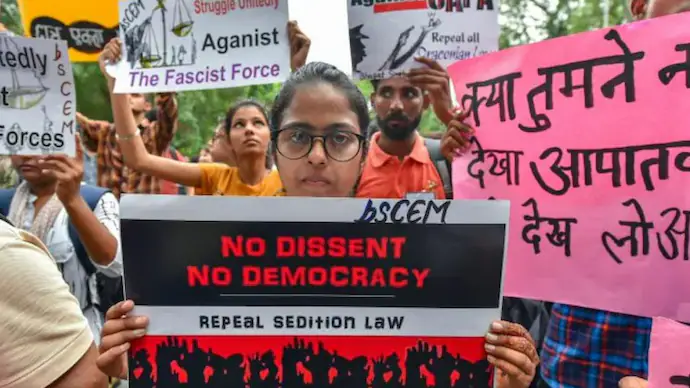
This case examines the constitutionality of Section 124A of the Indian Penal Code that criminalises sedition.
Petitioners Arguments
The provision of Section 124A conflates State with Government and thereby mistakenly reads disaffection towards the Government as disaffection against the State. Despite the legislation in place before the Parliament to replace the existing Penal Code, the enactment of a new law will not have retrospective effect. Therefore, there is still a need to adjudicate upon the constitutional validity of Section 124A. Since Section 124A is a pre-Constitutional enactment, it cannot carry the presumption of constitutionality that post-Constitutional enactments do Prior judgements like Kedar Nath Singh only tested Section 124A against Article 19(1)(a) . However, with evolving constitutional law doctrines, the Section must be re-evaluated against Article 14 and Article 21 as well. Section 124A was made a cognizable offence only by the Code of Criminal Procedure, 1973 , meaning that it was non-cognizable even during colonial times.
Responders Arguments
The State argued that this petition must not be referred to a larger bench since the Parliament is already in the process of re-enacting the provisions of the Penal Code and a Bill for that purpose has been placed before the Standing Committee.
Last Listed On
2025-09-15
Start Date
2023-09-12
Card Stage Date
2023-09-12
Review Petition No
W.P.(C) No. 682/2021
Case Status
Pending
Bench Status
Not Constituted
Subject Matter
Constitution
Pendency
2 years, 9 months, 18 days
7 Judge Bench
Reference to larger bench
Consider As Stage Of Pendency
true
Date of institution of case
Date of reference to larger Bench
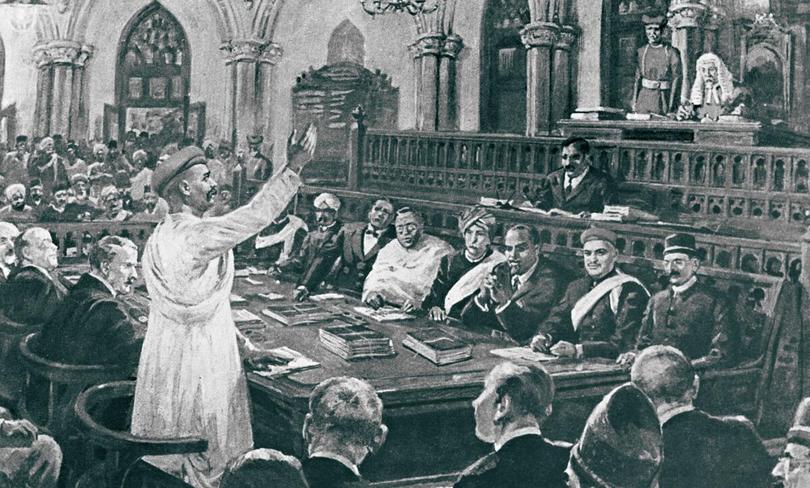
Section 124A of the Indian Penal Code , introduced in 1870, criminalizes sedition and disallows all forms of speech, representations, signage, etc. which are capable of exciting contempt and disaffection against the Government. This Section has been under scrutiny since independence for infringing upon the freedom of speech and expression. The Punjab High Court in Tara Singh Gopi Chand v. State in 1951, and the Allahabad High Court in Ram Nandan v. State 1959 ruled against Section 124A and found it to be unconstitutional and violative of free speech. However, a Constitution Bench of the Supreme Court, in 1962, upheld the validity of Section 124A of the Indian Penal Code in Kedar Nath Singh v. State of Bihar . The petition in the present case challenges the constitutional validity of Section 124A on the grounds that it is ultra vires Article 19(1)(a) , Article 14 and Article 21 of the Constitution of India On 12-09-2023, the three-judge bench of the Supreme Court referred the matter so that it may be heard by a bench of five or more judges if deemed appropriate by him.
Whether Section 124A of the Indian Penal Code is violative of Article 19(1)(a) , Article 14 and Article 21 of the Constitution of India?
Section 124A, Indian Penal Code
The Court referred the matter to the Chief Justice of India since any new Penal Code would only have a prospective effect. Therefore, existing prosecutions under Section 124A would still be governed by it and there is a need to examine its legality. In the past in Kedar Nath Singh , the validity of Section 124A was only tested on the basis of Article 19 . However, Article 19 is permeated by other fundamental rights like those under Article 14 and Article 21 and should not be examined in isolation.
Kedar Nath Singh v. State of Bihar, 1962 Supp (2) SCR 769
Kishorechandra Wangkhemcha v. Union of India
Date Of Institution Start
2021-02-23
Case No
W.P.(Crl.) No. 106/2021
Editors Guild of India v. Union of India
Date Of Institution Start
2021-05-13
Case No
W.P.(C) No. 552/2021
M/S Shreya Broadcasting Pvt. Ltd v. The State of Andhra Pradesh
Date Of Institution Start
2021-05-17
Case No
W.P.(Crl.) No. 216/2021
M/S Aamoda Broadcasting Company Private Limited v. The State of Andhra Pradesh
Date Of Institution Start
2021-05-17
Case No
W.P.(Crl.) No. 217/2021
M/S Shreya Broadcasting Pvt. Ltd v. The State of Andhra Pradesh
The Law of Sedition and India: An Evolutionary Overview
Source Of Info
The Hindu Centre for Politics and Public Policy
Date Of Fr
2022-08-27
What exactly is sedition? Why successive governments defended Section 124A
Source Of Info
India Today
Date Of Fr
2022-05-10
The law of sedition is unconstitutional
Source Of Info
The Hindu
Date Of Fr
2021-06-29
The art of dissolving dissent: India’s sedition law as an instrument to regulate public opinion
Source Of Info
LSE South Asia Blog
Date Of Fr
2019-10-04
N. Ravi v. Speaker, Legislative Assembly, Chennai
This case will answer whether privileges and immunities of the House of the Legislatures under Article 194 override freedom of press provided under Article 19.
Petitioners Arguments
The privileges and immunities in Article 194 cannot override the fundamental right to free speech under Article 19(1)(a) which also includes freedom of the press. The power of privileges and fundamental rights should be harmonised. It was also contended that the comments on the Chief Minister are on her utterances and do not constitute an interference in the proceedings of the House. It was also submitted that this issue has wide ramifications and therefore must be settled authoritatively.
Responders Arguments
The arguments of the Respondent are not available in the referral orders.
Last Listed On
2024-02-02
Start Date
2004-12-18
Card Stage Date
2004-12-18
Review Petition No
W.P. (Crl.) No. 206-210/2003
Case Status
Pending
Bench Status
To be reconstituted
Subject Matter
Constitution
Pendency
21 years, 6 months, 22 days
Awaiting bench reconstitution
Consider As Stage Of Pendency
true
Date of reference to 5 Judge Bench
Date of reference to 7 Judge Bench
On 7-11-2003, the Tamil Nadu Assembly issued warrants for the arrest of five senior journalists of the Hindu, an English national daily, and the Editor of Murasoli, A Tamil daily, for the publication of three articles pertaining to speeches given in the State Assembly by the then Chief Minister, Ms. Jayalalitha. These articles were suo moto referred to the Assembly’s Privileges Committee by the then Speaker, K Kalimuthu. The resolution passed by the Assembly stated that the editorial was written in a manner that caused breach of privilege of the action of the Assembly Speaker and the Privileges Committee and, in the process, imputed ulterior motives to the House as a whole. Writ Petitions were filed against these warrants before the Supreme Court by the journalists on 9-11-2003, along with an application to stay the arrest warrants. The arrest warrants were stayed by the Supreme Court on 10-11-2003. When the matter came up before the Division Bench, it was of the opinion that it involved substantial questions of interpretation of Articles 194(3) , Article 19(1)(a) and Article 21 of the Constitution. The Bench, therefore, on 8-12-2003, directed that the matter be placed before a Constitutional Bench of at least five judges. Similar issues pertaining to the extent and scope of Article 194 have previously come up before Constitutional Benches of the Supreme Court as well. The question of whether or not the privilege of the House under Article 194(3) would prevail over the fundamental right of citizens under 19(1)(a) was dealt with by a five judge bench in Pandit MSM Sharma v. Shri Sri Krishna Sinha AIR 1959 SC 395 . In this case, it was held that the freedom of speech and expression under Article 19(1)(a) must be read as subject to the powers, privileges and immunity granted to the House Under Article 194(3). However, in Re: Powers, Privileges and Immunities of State Legislatures AIR 1965 SC 745 , a seven judge bench observed that even though Article 194(3) is not subject to Article 19(1)(a), it is still subject to the fundamental right of protection of life and personal liberty guaranteed under Article 21. Taking note of the above judgments, the five judge Constitution Bench, on 8-12- 2004, referred the matter to an even larger bench of seven judges
Can privileges and immunities available under Article 194 override freedom of press provided under Article 19(1)(a) ?
Article 19(1)(a) of the Constitution
Article 194 of the Constitution
The division bench of the Supreme Court heard the case and concluded that since a substantial question of law regarding the interpretation of Articles 194(3), 19(1)(a), the relationship between these two articles, Article 21 and other articles of the Constitution, the matter must be heard by a five-judge bench, as per Article 145(3) . The five-judge bench heard the matter and stated that the observations made in Special Reference No. 1 of 1964 (1965) 1 SCR 413 (a seven-judge bench decision) contradict those made in Pandit M.S.M. Sharma v. Shri Sri Krishna Sinha & Ors. 1959 Supp. (1) SCR 806 (a five-judge bench decision), however, the former accepts the majority decision in the latter. The bench also further referred the matter to a seven-judge bench.
Special Reference No. 1 of 1964 [(1965) 1 SCR 413]
Pandit M.S.M. Sharma v. Shri Sri Krishna Sinha & Ors. [1959 Supp. (1) SCR 806]
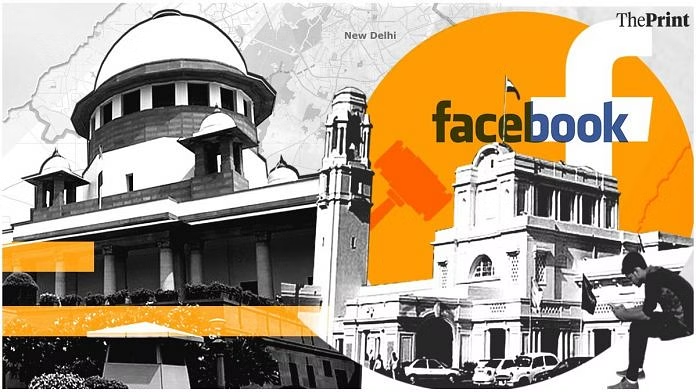
Why the Facebook summons case drew SC attention back to a case pending for 16 yrs now
Source Of Info
The Print
Date Of Fr
2021-07-13
Arjun Flour Mills v. State of Orissa
This case would clarify whether the State Legislature is competent to impose a surcharge on the total sales tax payable by a dealer.
Petitioners Arguments
That the State Legislature was not competent to enact the provision as per Article 246 read with Entry 54 List II of Schedule VII . That even though Hoechst Pharmaceuticals Ltd. v. State of Bihar upheld a similar provision it was based on an assumption that the State Legislature was competent to enact such a provision rather than on deliberation of the matter. T hat the view of the seven-judge bench in India Cement Ltd v. State of Tamil Nadu , which takes a different view is relevant to decide the validity of the provision.
Responders Arguments
That the State Legislature was within its competence to enact the provision.
Last Listed On
2024-01-09
Start Date
1999-10-06
Card Stage Date
1999-10-06
Review Petition No
C.A. No. 8763/1994
Case Status
Pending
Bench Status
To be reconstituted
Subject Matter
Constitution
Pendency
26 years, 8 months, 24 days
The provision, Section 5-A of Orissa Sales Tax Act, 1947 which imposed a surcharge on total sales tax payable by a dealer was challenged in this case. The main issue to be decided by the court is whether or not the State Legislature can pass a law levying a surcharge on sales tax. The Seventh Schedule of the Constitution clearly demarcates the subject matters of laws that can be made by the Parliament and State Legislatures respectively. Accordingly, sales tax on the sale and purchase of most goods (with a few exceptions) is the subject of state legislation. However, the Supreme Court needs to clarify whether a surcharge on sales tax would also fall under the category of “sales tax”. Given that a surcharge levied on the basis of one’s gross turnover is in the nature of a tax on income, which is a subject matter of parliamentary legislation. A three-judge bench of the Supreme Court, in Hoechst Pharmaceuticals Ltd. v. State of Bihar , upheld a similar provision under the Bihar Finance Act, 1981 which levied a surcharge on sales tax. The Bench held that levying surcharge was within the State Legislature’s competence as it was in the nature of sales tax. Another seven-judge Constitutional Bench, in India Cement Ltd. v. State of Tamil Nadu , has dealt with a similar legal issue where a cess was imposed on royalty payable for land excavation by the State Legislature. The State’s argument was that the cess was in the nature of land revenue, which is the subject matter of State Legislation under the Constitution. The Seven Judge Constitutional Bench, however, held that a cess on royalty for land excavation was not a cess on the land in question, but on the royalty itself, and therefore, outside the competence of the State Legislature. On 13-08-1998, a Division Bench of the Supreme Court referred to a five-judge bench in light of the two conflicting judgements mentioned above. The five-judge bench took note of the judgement passed in S Kodar v. State of Kerala where the validity of the Tamil Nadu Additional Sales Tax Act, 1970 . Under the provisions of this Act, an additional sales tax was levied on dealers of goods whose total turnover for a particular year exceeded Rupees Ten Lakhs. The Court held that the State Legislature was competent to pass such legislation as additional tax is really a tax on sale of goods. On 6-10-1999, Arjun Flour Mills was referred to a larger bench of seven judges in light of the above judgement. The matter is now pending before the Seven-Judge Constitutional Bench.
Whether the State Legislature was within its competence to enact Section 5-A of the Orissa Sales Tax Act, 1947 ?
Section 5-A of the Orissa Sales Tax Act, 1947
In the referral order to the five-judge bench, the court accepted that the argument of the petitioner’s counsel that Hoechst Pharmaceuticals Ltd. v. State Of Bihar was based on an assumption that the State Legislature was competent to enact such a provision, was justified. However, the court also stated that in this judgment it was held that the surcharge was in the nature of a sales tax and therefore within the competence of the State Legislature. The court referred the case to a seven-judge bench because the five-judge bench decision in S. Kodar v. State of Kerala would also have to be considered. In this case, with respect to the competence of the State Legislature, it was held that since the additional tax was a tax on aggregate sales in a year, therefore the State Legislature is permissible to legislate on such a matter under Entry 54 , which relates to tax on the sale of goods.
Hoechst Pharmaceuticals Ltd. v. State Of Bihar [1983 AIR 1019]
India Cement Ltd v. State Of Tamil Nadu [1990 AIR 85]
S. Kodar v. State Of Kerala [1974 SCC (4) 422]
Sambalpur Merchants Association v. State of Orissa
Surcharge under Orissa Sales Tax Act must be levied before deducting Amount of Entry Tax paid by a dealer: SC [Read Judgment]
Source Of Info
TAXSCAN
Date Of Fr
2016-10-31
‘Royalty’: a Tax? : An Analysis of the Judicial Uncertainty and its Service Tax Implications
Source Of Info
India Corp Law
Date Of Fr
2018-07-17
Rojer Mathew v. South Indian Bank Limited
This case deals with the classification of the Finance Act, 2017 as a money bill given that it also dealt with issues relating to administration of tribunals.
Petitioners Arguments
A bill must only contain provisions that pertain to the matters mentioned under Article 110 (1) (a) to (g) for it to be classified as a money bill. The provisions under Part XIV of the Finance Act legislated on several aspects of tribunals that did not pertain to any subject matter under Article 110(1) (for eg, the conditions of service of presiding officers of tribunals). Therefore it couldn’t be classified as a money bill. The Finance Act, 2017 lost its ‘money bill characteristic’ by virtue of the inclusion of Part XIV. Therefore, passing it without the assent of the Rajya Sabha was ultra vires of the Constitution. The Parliament draws its power to legislate on tribunals from Entry 11(a) of List III, Seventh Schedule , which deals with ‘administration of justice’, and has no nexus with financial matters. Thus passing Part XIV of the Finance Act, 2017 as part of a money bill was in direct violation of this. Through Part XIV, (specifically through Section 184) the legislature empowered the Central Government (Executive) to make rules for terms, salaries (violating the “doctrine of excessive delegation”) thus making tribunals amenable to the “whims and fancies” of the largest litigant, the State. This would interfere not only with the independence of the judiciary and separation of powers, which is integral to the basic structure of the Constitution but also with the administration of justice. Citing the minority opinion in K.S. Puttaswamy v. Union of India [(2019) 1 SCC 1] , the petitioners argued that the Court could look into the Speaker’s decision and the power to determine whether a breach amounted to “irregularity in procedure” or “illegality” lies with the Court.
Responders Arguments
It is well settled that the parameters for a bill to qualify as a money bill had to be interpreted in the widest amplitude and that the same principle should be extended to the Finance Act, 2017. The Act had the “dominant character” of a money bill and the related matters (here, Part XIV) would, by extension, have characteristics of a money bill. A part of the bill could not be isolated from being a “money bill”. The certification is provided to the entire bill. The Speaker of the Lok Sabha is the only constitutional authority to determine whether a particular bill was a money bill (under Article 110(3)) and the Speaker’s decision is final and not subject to judicial review. In the alternative, the Speaker’s decision on whether a bill was a money bill, was a procedural one in the nature of “proceedings in Parliament” and therefore, as per Article 122 (a) of the Constitution , it cannot be called into question in this court. Administration of tribunals through their respective enactments lead to several inconsistencies and anomalies, pointing to the difference in status, terms of service, age of superannuation etc. Part XVI of the Act was introduced to resolve these discrepancies. The practice of according ranks equivalent to judges of constitutional Courts to the presiding officers of tribunals (followed before the introduction of the Finance Act) was inherently contradictory considering the difference in their functions. Further, this practice has created problems in the administration of justice. The Finance Act, 2017 was brought in to rid the system of said problems arising out of the system of ranks and status. The Government was merely giving effect to directions and recommendations by the Court to bring about uniformity in the service conditions of tribunals and the Act was not arbitrary. Introducing individual amendments for each tribunal would have been impractical and a single enactment was made to harmoniously bring uniformity.
Last Listed On
2023-10-12
Start Date
2019-11-13
Card Stage Date
2019-11-13
Review Petition No
Civil Appeal No. 8588/2019
Case Status
Pending
Bench Status
To be reconstituted
Subject Matter
Constitution
Pendency
6 years, 7 months, 17 days
This case dealt with the rights and duties of a bank during the auction of secured assets, as part of the debt recovery process. The decision of the Kerala High Court in the matter was appealed in front of the Supreme Court. During the Supreme Court hearings, it was discovered that the appointment norms and functioning of the Debt Recovery Tribunal were not in consonance with the principle of judicial independence. The norms for appointment and functioning of the Debt Recovery Tribunal were found to be non-compliant with observations made in relevant Supreme Court precedents. In light of this, the Court felt the need to revisit the structure and functioning of tribunals. Meanwhile, the Legislature enacted the Finance Act, 2017 ; Part XIV of this Act introduced changes to the administration of tribunals. Though a significant portion of the Act (Part XIV) did not pertain to matters of finance, the government introduced these changes and enacted the statute as a money bill in parliament. This resulted in questions over the scope of the money bill and whether the process for enacting the money bill was used to bypass parliamentary procedures in this case. Matters regarding the reform of tribunals were clubbed along with issues pertaining to modalities of the Finance Act, 2017 and were decided upon by the Five Judge Bench of the Supreme Court. The Supreme Court, while suggesting certain reforms to the Tribunals system struck down the rules framed to govern tribunals. The five-judge bench however referred to the issue of the scope of a money bill under Article 110 , and by extension, whether the Finance Act could have been enacted as a money bill to a seven-judge bench of the Court.
Does the Finance Act, 2017 satisfy the test to be classified as a “money bill”’? Is Section 184 of the Finance Act, 2017 unconstitutional on account of Excessive Delegation? Are Tribunal, Appellate Tribunal, and other Authorities (Qualifications, Experience and other Conditions of Service of Members) Rules, 2017 in consonance with the Finance Act, 2017 and various decisions of this Court on the functioning of Tribunals? Should there be a Single Nodal Agency for the administration of all Tribunals? Is there a need for conducting a Judicial Impact Assessment of all Tribunals in India? Are judges of Tribunals set up by Acts of Parliament under Articles 323-A and 323-B of the Constitution equal in rank and status with Constitutional functionaries? Do direct statutory appeals from Tribunals to the Supreme Court ought to be detoured? Is there a need for amalgamation of existing Tribunals and setting up of benches?
Part XIV of The Finance Act, 2017
The Court observed that in Justice K.S. Puttaswamy v. Union of India , (2019) 1 SCC 1 , the majority ruled that the Aadhar Act was a money bill without laying down interpretation of relevant provisions and the scope of Article 110(1) . Considering that this bench was of the same strength as that of the Puttaswamy judgement (5 judge bench), the Court deferred this particular issue to a larger bench. It additionally felt that questions of the jurisdictional relationship between the High Courts and tribunals, the appointment of a nodal ministry/independent supervisory body to oversee tribunals or the lack thereof addressed by the seven-judge bench L. Chandra Kumar v. Union of India, (1997) 3 SCC 261 had to be looked at again. Therefore it had to be referred to a seven-judge bench.
Justice K.S Puttaswamy v. Union of India [(2019) 1 SCC 1]
Delegated Legislation: The Blindspot Of The Parliament
Source Of Info
The Wire
Date Of Fr
2019-05-16
Column: Decoding the Tribunal Judgment
Source Of Info
Bar and Bench
Date Of Fr
2019-11-15
Money Bills and the Future of the Rajya Sabha
Source Of Info
Economic and Political Weekly
Date Of Fr
2019-11-24
Subhash Desai v. Principal Secretary, Governor of Maharashtra
This case deals with the Speaker’s power to disqualify MLAs while a motion for his removal is pending before the House.
Petitioners Arguments
A five-judge bench of the Court has already decided the specific issue in the case of Nabam Rebia v. Deputy Speaker . In that case, it was held that the Speaker cannot conduct disqualification proceedings while a motion for their own removal was pending. Therefore, no substantial question of law is pending before the Court and hence reconsideration by a larger bench is not needed.
Responders Arguments
The Nabam Rebia judgment requires reconsideration because it allows defecting MLAs to avoid disqualification proceedings by initiating a motion for removal of the Speaker.
Last Listed On
2023-10-12
Start Date
2023-05-11
Card Stage Date
2023-05-11
Review Petition No
W.P.(C) No. 493/2022
Case Status
Pending
Bench Status
To be reconstituted
Subject Matter
Constitution
Pendency
3 years, 1 month, 19 days
Judgment pronounced by 5 Judge Bench
In June, 2022, members of the ruling party in Maharashtra, led by Mr. Eknath Shinde, split from the party. Following this, disqualification proceedings were initiated against them on the grounds of defection . A floor test was also requested against the State government on the ground that the Chief Minister, Mr. Uddhav Thackeray, no longer enjoyed majority confidence. The dispute between the two factions came before the Supreme Court in the present case. A five-judge bench of the Court had to decide, inter-alia, whether the splitting faction could be subjected to disqualification proceedings under the 10th Schedule of the Constitution and whether the Governor’s decision of holding the floor test was legal. The bench held on 11-05-2023 that the Governor had no grounds to call for a floor test and that the Legislative Speaker would decide whether the actions of the splitting faction amounted to defection. The bench, however, referred the question of whether the Speaker can oversee disqualification proceedings while a motion for his removal is pending to a seven-judge bench.
Can the Speaker decide disqualification proceedings against MLAs under the 10th Schedule of the Constitution when a motion for his removal is pending before the House?
Article 179 of the Constitution
Article 181 of the Constitution
10th Schedule of the Constitution
Among other things, the Court stated that Nabam Rebia is in conflict with the judgement in Kihoto Hollohan v. Zachillhu because the decision in Kihoto Hollohan holds that there is no reason to doubt the independence and impartiality of the Speaker when adjudicating on proceedings under the 10th Schedule while Nabam Rebia held the opposite. In Nabam Rebia , while interpreting the phrase “all the then members” in Article 179(c) , the Court did not look at the entirety of the discussion in the Constituent Assembly regarding other provisions of the Constitution. Article 181 of the Constitution states that the Speaker will not preside over a sitting of the Legislative Assembly if a resolution for their removal is under consideration. However, Nabam Rebia did not consider whether this restriction would extend to other functions of the Speaker like overseeing disqualification proceedings.
Nabam Rebia v. Deputy Speaker, Arunachal Pradesh Legislative Assembly
Shri Bharat Gogawale v. Deputy Speaker Maharashtra State Legislative Assembly