Kantaru Rajeevaru v. Indian Young Lawyers Association
This case is a constitutional reference arising from a review petition filed in the case of Indian Young Lawyers Association v. State of Kerala that struck down the bar on entry to the Sabarimala Temple for women of ‘menstruating age’. The reference will settle constitutional questions around the scope and nature of the rights under Article 25 and 26 of the Constitution.
Petitioners Arguments
Right to practice religion under Article 25 also includes alignment with, and autonomy to follow the core religious practices and observances of a community. It cannot be used as a ground by individuals to override the collective rights of worship of other believers. Article 25 covers the right of a community to follow its religious practices that should be exclusively derived from its internal, subjective doctrines. Article 25 and 26 must be read together to avoid conflict between the provisions. While Article 25(2)(b) allows the state the limited power to undertake social reform or open up temples and religious institutions to all sections of Hindus, it cannot be said to override the right of denominations under Article 26 to manage their religious affairs. Article 26 is not subject to Article 25 or any other Fundamental Right in the Constitution as the Constitution explicitly avoids mentioning any such restriction in Article 26 in the manner of Article 25(1). In the pluralistic religious landscape of India, the word denomination must be widely interpreted and must be understood in terms of the indigenous construct of ‘Sampradaya.’ It must also include under its sweep, sub-groups or sub-denominations. Constitutional morality cannot serve as an independent ground for judicial review as it is vague and subjective, and thus, cannot be applied to test the validity of religious practices under Article 25. ‘Morality’ in Articles 25 and 26 refers to ‘societal’ or ‘public morality’, and not constitutional morality. The Supreme Court must set a high threshold for entertaining PILs questioning a religious practice filed by a person not belonging to that religion. Third parties should not ordinarily be allowed to reshape religious practices while not being adherents themselves. It should not be left to the courts to determine what constitutes an essential or integral part of a religion. Such a conclusion must necessarily stem from only the internal belief system of a particular religious group. Courts should limit themselves to determining the distinction between religious and secular matters only. The words ‘sections of Hindus’ only refers to the different sects, castes and sub-castes within Hinduism, judging from historical context.
Responders Arguments
Religious freedom under Article 25(1) is not absolute and is limited to only essential religious practices. The provision is subject to constitutional principles and cannot be cited to validate discriminatory or exclusionary practices. The freedom of religious denominations to manage their religious affairs under Article 26 cannot be read as overriding the freedom of an individual to practice religion under Article 21 . Individual right must prevail over denominational right in case of conflict. Article 26 is subject to the core constitutional mandates of equality, dignity and non-exclusion inherent in many provisions of Part III of the Constitution including Articles 14 , 19 , 21 and 25. Article 26 should be read along with these provisions as a whole, and as part of the broader constitutional framework. ‘Morality’ in Articles 25 and 26 refers to constitutional morality that is rooted in the core constitutional values of liberty, equality, fraternity and justice. Religious practices cannot prevail over these values by sanctioning exclusion or undermining the autonomy of individuals in the name of public or societal morality. Judicial review of religious practices must go beyond simply separating religious matters from secular ones. Courts should assess whether a religious practice is essential, but the key test should be its consistency with fundamental rights and constitutional values, not theological correctness. The words ‘sections of Hindus’ must be given a broad, purposive reading to include all classes historically subjected to exclusion from temple entry and by virtue of that, should necessarily encompass gender as a class in addition to castes or sects within Hinduism.
Last Listed On
2026-05-14
Start Date
2019-11-14
Card Stage Date
2019-11-14
Review Petition No
R.P.(C) No: 3358/2018
Case Status
Pending
Bench Status
Constituted
Subject Matter
Constitution
Pendency
6 years, 7 months, 16 days
9 Judge Bench
Judgement Reserved
Consider As Stage Of Pendency
true
Date of institution of case
Date of reference to 9 Judge Bench
Judgement reserved
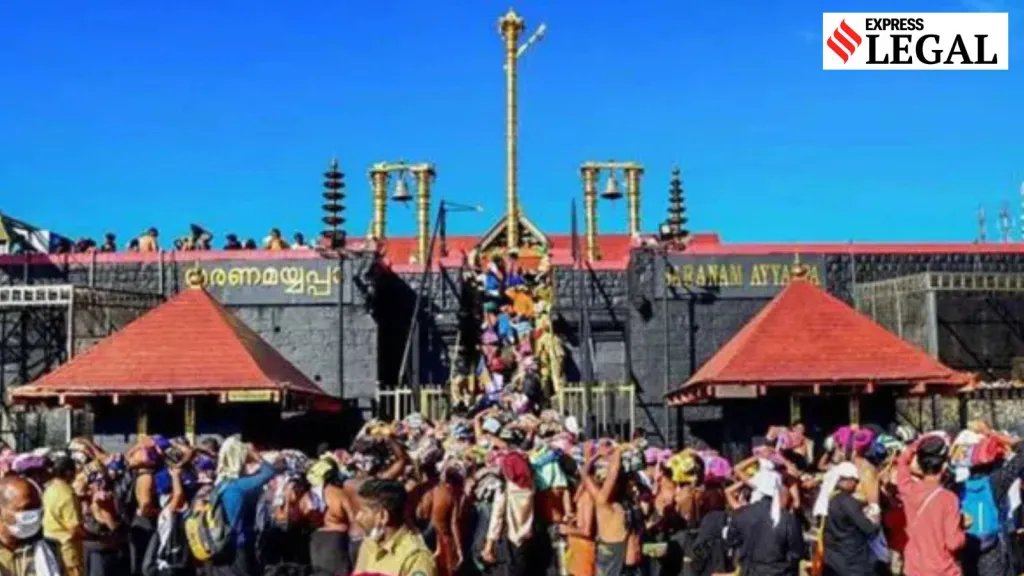
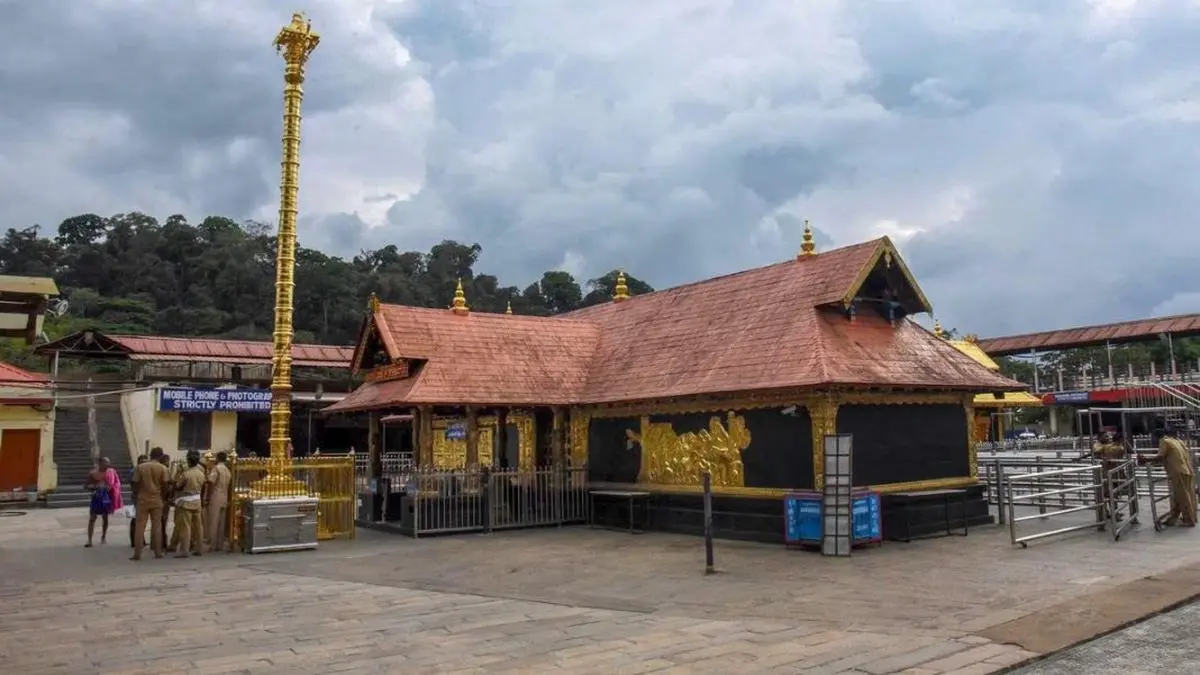
Sabarimala Sree Dharma Sastha Temple (or commonly known as the Sabarimala Temple), located in Kerala, is a place of worship of Lord Aiyappa. This deity is considered celibate and therefore, since time immemorial, menstruating women between the age between 10 and 50 years have been denied entry into the temple. When a challenge to this practice was filed, the Kerala High Court held that the exclusion was constitutional and justified, as the practice had been a long-standing custom. In 2006, the Indian Young Lawyers Association filed a writ petition in the Supreme Court challenging the validity of Rule 3(b) of the Kerala Hindu Places of Public Worship (Authorisation of Entry) Rules, 1965 which restricted the entry of women into the temple. The Association argued that the custom violated the female worshipper’s right to equality under Article 14 and the freedom of religion under Article 25. In 2018, a Constitution Bench with 4:1 majority, on the basis of the same rationale, allowed the entry of women irrespective of age into the Temple. It also struck down the state legislation and deemed it unconstitutional . As a consequence, around 65 review petitions challenging the verdict were filed. The petitioners include the National Ayyappa Devotees (Women) Association, the Nair Service Society, and the All Kerala Brahmins Association. Since the decision in this main case would have implications on other cases involving religious practices, such as muslim women’s right to pray in mosques , the Parsi women’s right to enter a Fire Temple after having married a non-Parsi , and the practice by the Dawoodi Bohra community of female genital mutilation , the Constitution bench decided to refer certain questions of law to a larger bench. In the meanwhile, the decision in the review petitions filed against the 2018 judgment were kept pending. In February 2020, a 9 Judge bench upheld the power of the Supreme Court to refer certain questions to a larger bench, even in the case of a review petition. On 16 February 2026, the 9 Judge Bench was reconstituted and oral hearings commenced from 7 April.
What is the scope and ambit of the right to freedom of religion under Article 25 of the Constitution of India? What is the inter-play between the rights of persons under Article 25 of the Constitution of India and rights of religious denomination under Article 26 of the Constitution of India? Is the right of a religious denomination under Article 26 of the Constitution of India subject to other provisions of Part III of the Constitution of India, apart from public order, morality and health? What is the scope and extent of the word ‘morality’ under Articles 25 and 26 of the Constitution of India and is it meant to include Constitutional morality? What is the scope and extent of judicial review with regard to a religious practice under Article 25 of the Constitution of India? What is the meaning of expression ‘Sections of Hindus’ occurring in Article 25(2)(b) of the Constitution of India? Can a person not belonging to a religious denomination or religious group question a practice of that religious denomination or religious group by filing a public interest litigation?
Rule 3(b) of the Kerala Hindu Places of Public Worship (Authorisation of Entry) Rules, 1965
Articles 25 and 26 of the Constitution of India
The Court observed that several writ petitions had been filed along with the Sabarimala review petition, all of which collectively involved multiple overlapping issues relating to the determination of what was integral or essential to a religion, the clash between individual and collective rights to practice religion, and the entry or exclusion of certain sections, especially women from religious spaces. Declaring that the Court should pronounce an authoritative opinion to put to rest these recurring issues flowing from the rights under Articles 25 and 26 of the Constitution, it framed seven key questions and referred the petition to a larger bench
Commissioner Hindu Religious Endowments, Madras v. Shri Lakshmindra Thirtha Swaminar of Sri Shirur Mutt
Durgah Committee, Ajmer vs. Syed Hussain Ali & Ors.
Indian Young Lawyers Association v. The State of Kerala
Central Board of Dawoodi Bohra Community v. State of Maharashtra
Sabrimala Custom Protection Forum( A Registered Society) Secretary v. Indian Young Lawyers Association Through Its General Secretary Through General Secretary
The Right to Worship vis-a-vis Gender Parity In India: The Sabarimala Issue
Source Of Info
Indian Law Institute Law Review
Sabarimala recap: Key takeaways from Supreme Court’s 16-day marathon hearing
Source Of Info
The Indian Express
Date Of Fr
15-05-2026
The Sabarimala U-turn
Source Of Info
Frontline
Date Of Fr
14-04-2026
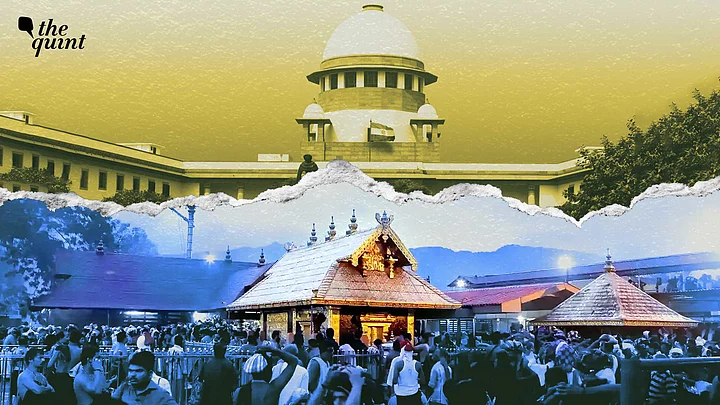
As Sabarimala Plays Out in Supreme Court, the Stakes Now Go Far Beyond Entry
Source Of Info
The Quint
Date Of Fr
10-04-2026
The stakes are high in the Sabarimala matter
Source Of Info
Hindustan Times
Date Of Fr
22-04-2026
State of Uttar Pradesh. v. Jai Bir Singh
This case deals with the definition of the term "industry" under S. 2(j) of the Industrial Disputes Act, 1947.
Petitioners Arguments
It was urged on behalf of the employers that the meaning given to the word ‘industry’ in the judgment of Bangalore Water Supply and Sewerage Board v. A. Rajappa ([1978] 2 SCC 213) , is not warranted by the language used in the definition clause. The Government and its Departments while exercising its ‘sovereign functions’ have been excluded from the definition of ‘industry’. In a constitutional democracy where sovereignty vests in the people, all welfare activities undertaken by the State in discharge of its obligation under the Directive Principles of State Policy contained in Part IV of the Constitution are ‘sovereign functions’. There is no unanimity in the opinions expressed by the judges in the Bangalore Water case on the ambit of the definition of ‘industry’. If in response to the opinions expressed by the seven judges in Bangalore Water case, the legislature intervened and provided a new definition of the word ‘industry’ with exclusion of certain public utility services and welfare activities, the unamended definition should be construed and understood with the aid of the amended definition, which although not brought into force is nonetheless part of the statute.
Responders Arguments
On behalf of the employees, it was argued that the decision in the case of Bangalore Water, being in the field as binding precedent for more than 23 years and having been worked to the complete satisfaction of all in the industrial field, on the principle of stare decisis, this Court should refrain from making a reference to a larger Bench for its reconsideration. It was urged that upsetting the law settled by Bangalore Water is neither expedient nor desirable. It was further pointed out that earlier an attempt was made in Aeltemesh Rein v. Union of India, ([1988] 4 SCC 54) to seek enforcement of the amended Act through this Court. The Union came forward with an explanation that for employees of the categories of industries excluded under the amended definition, no alternative machinery for redressal of their service disputes has been provided by law and therefore, the amended definition was not brought into force.
Last Listed On
2026-03-19
Start Date
2017-01-02
Card Stage Date
2017-01-02
Review Petition No
C.A. No. 897/2002
Case Status
Pending
Bench Status
Constituted
Subject Matter
Labour Laws
Pendency
9 years, 5 months, 28 days
Date of reference to 7 Judge Bench
In 1978, the definition of industry under the Industrial Disputes Act, 1947 was determined by the seven-Judge bench in the Bangalore Water Supply case . The definition of the term 'industry' in Section 2(j) is both exhaustive and inclusive. It can be divided in two parts ; First part provides any business, trade, undertaking, manufacture or calling of employers, and the second part provides any calling, service, employment, handicraft, or industrial occupation or avocation of workmen. The Supreme Court conducted triple tests to ascertain what shall be included and to be excluded in the sphere of the definition, which included systematic activity, co-operation between employer and employee and production of goods and services which satisfy human wants. Pursuant to the observations made by the judges in their different opinions in the judgment, the legislature responded and amended the Act by Industrial Disputes (Amendment) Act 1982. Parliament created certain exceptions to the definition, but the same was never brought into force and existing definition of industry given under Section 2(j) of the Act remained valid. In 2005, the present case was brought about on the question, if 'social forestry' department of state, which was a welfare scheme undertaken for improvement of the environment, would be covered by the definition of 'Industry' under S. 2(j) of the Industrial Disputes Act, 1947 and the five-Judge bench referred the Bangalore Water Supply case to a larger bench for reconsideration. In 2017, a seven judge bench of the Supreme Court passed an order for the constitution of a nine-Judge bench in light of the 2005 referral order
Whether ‘social forestry’ department of State would be covered by the definition of ‘‘Industry’’ under Section 2(j) of the Industrial Disputes Act, 1947 ?
Section 2(j) of the Industrial Disputes Act, 1947
The Court concluded that a reference to a larger bench for reconsideration of the Bangalore Water decision was required because the case was not a unanimous decision. The majority opinion that was expressed in the decision was tentative and temporary. The judges wanted the legislature to intervene and clarify the legal position by simply amending the definition of 'industry'. The legislature did respond by amending the definition of 'industry', but unfortunately, was unable to provide Alternative Dispute Resolution Forums to the employees of specified categories of industries excluded from the amended definition, resulting in more than 23 years delay in enforcing the amendment. The legal position therefore continued to be unclear and to a large extent uncovered by the decision of the Bangalore Water Supply case. The seven-Judge bench, in light of the of the judgement delivered by the five-Judge bench on this case and the decision of the court in the Bangalore Water case, observed that as serious doubts were expressed in the reference order about the correctness of the views taken in Bangalore Water Supply case and the issue under consideration has serious and wide ranging implications, the matter needs to be placed before nine- Judge bench.
Bangalore Water Supply & Sewarage Board v. A. Rajappa
Conservator of Forests v. Jagannath Maruti Kondhare
State of Gujarat v. Pratamsingh Narsinh Parmar
Aeltemesh Rein v. Union of India
State of Bombay v. Hospital Mazdoor Sabha
Coir Board v. Indira Devi
Central Board of Dawoodi Bohra Community v. State of Maharashtra
K. Brandy v. England Revenue Commissioner
Regina v. Secretary of State for the Home Department