"पहली बार जब वल्नरेबल लोग 'पुलिस केस' सुनते हैं, वे नहीं चाहते की केस में फस जाए। उनके लिए यह एक डरावने सपने जैसा होता है। अदालत की प्रक्रिया इतनी पेचीदा होती है कि उनको पता नहीं होता कि किस वकील से संपर्क करें, और कैसे एप्लीकेशन भरे। वे बारिश और ठंड में 10, 20 किलोमीटर चलके आते हैं। उनको विश्वास दिलाने के लिए पंचायत और ब्लॉक लेवल में कानूनी सेवाओं की जरूरत ह।" "When vulnerable persons hear 'police case' for the first time, they don't want to get caught in the case. It's like a scary dream for them. Courtroom proceedings are so complex that they don't know which lawyer to contact, how applications must be filed. They walk 10, 20 km in the rain and the cold. To build their hope in the system, legal services must be provided at the panchayat and block level." In Episode 4 of JALDI's new video series, "Designing Justice", Mukesh Paswan, an advocate practising at the Muzaffarpur Civil Court in Bihar and a Fellow with Nyaaya's Samvidhaan Fellowship, speaks about his experiences representing litigants and vulnerable persons and shortcomings in existing District Court infrastructure. He highlights the need for ensuring better-trained staff, continuous monitoring and improved access to basic facilities such as washrooms and digital displays, for ensuring that the justice system becomes more accessible for all. JALDI is committed to ensuring universal accessibility for all, building on our Court Design Handbook: Design Guide for User-Centric District Courts in India.
"Real change begins when we share our experiences and discuss beyond barriers, beyond disciplines, and beyond silos." Over the last six months, the JALDI team at Vidhi dived into real stories, real challenges, and practical ideas for designing people-centric courts through interviews with stakeholders from the system, from advocates with disabilities and legal aid lawyers, to social workers, academics, ISL interpreters, and architects and accessibility experts. The conversations revolved around the current experiences of seeking justice in Indian courts, highlighting challenges with physical and digital infrastructure and long, drawn-out, opaque processes. The interviewees draw from their diverse backgrounds to ideate potential solutions that can be implemented, from addressing systemic challenges to the need for greater sensitisation and awareness sessions. Join the conversations to build the courts of our future together! Explore the full playlist on YouTube . JALDI is committed to ensuring universal accessibility for all, building on our Court Design Handbook: Design Guide for User-Centric District Courts in India.
"Some accessibility features exist in courts, but operations and maintenance are still lacking. 'Accessible' washrooms, for example, often end up being used as storage. To ensure continued upkeep and constant evolution of solutions being adopted, we need audits which are not just a checklist but also an experiential understanding. We have to understand how each person, from the judge to the lawyer, the witness, the staff, the facility management team, and others, interact with the Court Complex, to strategise and devise feasible design solutions. Accessibility is not a choice. We need a holistic system to monitor this, not just fragmented interventions..." JALDI's video series, "Designing Justice", draws from our ongoing work on ensuring accessible, adaptable and safe court infrastructure for India, as articulated in our 2024 publication "Court Design Handbook: Design Guide for User-Centric District Courts in India". We conclude the series by conversing with Shreya Shetty and Bhagyalaxmi Madapur, architects, accessibility experts, co-founders of 369 Ochre Studio and co-authors of the Court Design Handbook, on their experience interacting with courts from an architectural and accessibility lens. Shreya and Bhagya trace their journey with court infrastructure, and discuss the need for sustained multidisciplinary engagement to ensure more inclusive court design and monitoring. JALDI is committed to ensuring universal accessibility for all, building on our Court Design Handbook: Design Guide for User-Centric District Courts in India.
"Legal aid systems for prisoners have improved over the years, with more awareness and full-time salaried legal aid defence counsels appointed by the Legal Services authorities. Nonetheless, some prisoners will still plead guilty to avoid having to wait for years for the trial to get over. Fellow prisoners, prison officials or even judges and lawyers sometimes lure the prisoners to plead guilty, especially for petty offences. There's one kind of justice for these people, and another kind of justice for people who have access to resources and to lawyers... " In Episode 7 of JALDI's new video series, 'Designing Justice', Professor Vijay Raghavan from the Tata Institute of Social Sciences' Centre for Criminology and Justice and Project Director of TISS' Prayas field action programme undertaking social work in criminal justice, takes us through the journey faced by prisoners under trial as they interact with the criminal justice system. He reflects on his experience to highlight the need for tackling asymmetry in access to legal aid and support, efficient and conscientious trial processes, addressing mental health needs of prisoners, and strategies for advocacy and policy reform within the system. JALDI is committed to ensuring universal accessibility for all, building on our Court Design Handbook: Design Guide for User-Centric District Courts in India.
"For children, we really have to give a detailed explanation of how the process works, who will be there to support them, and so on. Even though we try to make them understand where they have to go, many of the kids in the waiting area are puzzled and don't know what is happening. They stand in corridors and sometimes have to witness arguments in the courtroom. We need more awareness of Vulnerable Witness Deposition Centres and other facilities to help make them feel comfortable..." In Episode 6 of JALDI's new video series, ‘Designing Justice’, Arushi Anthwal and Jova Rachel from Counsel to Secure Justice draw on their experience working as advocates and support persons for children in courts. They reflect on how children currently experience court infrastructure and the ways in which it shapes their ability to feel supported while navigating the system. They also explore how trauma-informed design can help build rapport with children and move the system toward more meaningful justice. JALDI is committed to ensuring universal accessibility for all, building on our Court Design Handbook: Design Guide for User-Centric District Courts in India.
"If a deaf person is coming to court, people are shocked. They think, 'oh these people also [can come to court]!' These are real human beings, not aliens standing in a courtroom. It's very normal. Interact with them directly. As a sign language interpreter, I am not a decision-maker. I convey the meaning and their responses. But sometimes people just decide among themselves without giving a chance to the deaf person to participate..." Courts in India have begun to recognise the need for linguistic and communicative accessibility for diverse users. From the Supreme Court acknowledging the importance of interpreters in Constitution Bench hearings , to High Courts such as Delhi and Karnataka issuing directions for engaging sign language interpreters, the judiciary is gradually taking steps towards improving inclusivity. However, there is still a long way to go for truly accessible courts. In Episode 5 of JALDI's new video series, "Designing Justice", Priyanka Kalyan, a trained Indian Sign Language interpreter, reminisces on her experiences interpreting for deaf persons in courts. She highlights the need for the system to provide adequate resources and support for deaf persons and interpreters for breaking communication barriers, and calls for a change in mindset to ensure that persons with disabilities are truly made to feel welcome in the legal system. JALDI is committed to ensuring universal accessibility for all, building on our Court Design Handbook: Design Guide for User-Centric District Courts in India.
"We ourselves as advocates are drained by the long process of waiting for our cases to be called. But imagine the children, who come to the Family Courts and even the POCSO Courts, waiting at the mediation centres or for cases for hours without food or water. Toilets are also at extreme ends of the Complex, which is difficult for the children to navigate. There are only a few toys for select age groups, and no facilities for older children to engage themselves while at the court." In Episode 3 of JALDI's new video series, "Designing Justice", Meghana Muddurangappa, an advocate who has practised before the Supreme Court and the Karnataka High Court and is an Associate with the Dhwani Legal Trust, discusses her experience in trying to make litigants, especially first-time visitors, feel safe and comfortable with the justice system; what we must do to ensure that courts are inclusive for vulnerable persons, including children; and why the physical space of courts must be improved in addition to digital transformation in the near future. JALDI is committed to ensuring universal accessibility for all, building on our Court Design Handbook: Design Guide for User-Centric District Courts in India.
"I have to reach the court before it starts, and tell the Court Master that I will be appearing in a matter today and request support, from removing chairs which may be obstacles for wheelchairs to informing the judge that I require additional assistance. Everyone is very kind, but in the early days it was not easy at all..." In Episode 2 of JALDI's new video series, "Designing Justice, " Arvind, a lawyer with cerebral palsy practising before the Delhi High Court and the Supreme Court and the founder of Verdict Legal Solutions, shares his experiences with the system. He highlights how the support of judges, fellow lawyers and Registry staff is crucial for helping persons with disabilities navigate the courts, and why we must ensure that courts become truly accessible, from providing online causelists to canteens for all. JALDI is committed to ensuring universal accessibility for all, building on our Court Design Handbook: Design Guide for User-Centric District Courts in India.
"Are our courts not accessible because we don't have lawyers with disabilities, or do we not have lawyers with disabilities because courts are not accessible? We have to start somewhere: we need to integrate universal design in all walks of life, at all courts. It has to start with conversations about disability in law schools and judicial academies. Sensitisation cannot happen when someone starts working as a lawyer or a judge; it has to happen at a foundational stage. This will help make continued training and sensitisation programs more effective." December 3rd marks the International Day of Persons with Disabilities. In Episode 1 of JALDI's new video series, "Designing Justice", Anchal Bhateja, Research Fellow at Vidhi and Consultant, Mission Accessibility and Founder of QAble, shares her experiences navigating courts as one of the first blind women lawyers to appear before the Supreme Court of India. JALDI is committed to ensuring universal accessibility for all, building on our Court Design Handbook: Design Guide for User-Centric District Courts in India.
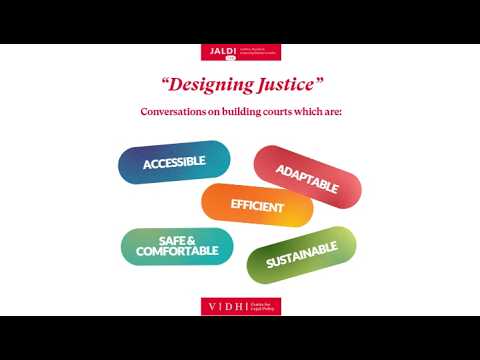
Introducing “Designing Justice”, JALDI’s new video series where we explore what it truly means to build accessible, inclusive and future-ready courts in India. As India moves toward a stronger digital and physical court infrastructure, big questions remain: What do users actually experience? What does meaningful accessibility look like? And how can court spaces better serve the people who depend on them? Building on our Court Design Handbook, this series dives into real stories, real challenges and practical ideas for designing courts that put people first. Join us from December 3rd as we rethink how justice is experienced by all, from the moment someone enters a Court Complex.
Constitution Benches of the Supreme Court play a crucial role in interpreting the Constitution of India—but how often are they constituted? Who are the key voices in these landmark decisions? And how much time do judges devote to these fundamental questions of law? Join us for an insightful panel discussion as we delve into these pressing questions and more. Speakers Aparna Chandra (Professor of Law, National Law School of India University) Jayna Kothari (Senior Advocate and practices in the Supreme Court) Nick Robinson (Independent Scholar) Moderator Shruthi Naik (Senior Resident Fellow, JALDI) Presenting JALDI's work on Constitution Benches Jyotika Randhawa (Research Fellow, JALDI) Date: 18th February 2025 (Tuesday) Time: 6:00 PM – 7:30 PM (High tea at 5:45 PM) Venue: Bangalore International Centre
ABOUT THE SERIES Legal issues and research often tend to be an amalgamation of complex and abstract ideas, an obstacle for non-legal (and some legal) professionals to actively engage with the law. Empirical research brings a sense of objectivity and provides new insights into the workings of law and legal institutions. To that end, Vidhi Centre for Legal Policy is launching a Public Lecture Series titled ‘The Law through the Lens of Hard Data.’ The series will provide a platform for Indian scholars, professionals, and academicians working with empirical data to describe, analyse and understand the law and legal institutions. ABOUT THE LECTURE Despite inheritance law reform towards gender equality, Indian families rarely transfer immovable property to women. Given this, do women use courts to claim their rights? If so, who opposes them? What kind of property is disputed? Do judgements favour women? And what does the language of judgements reveal? Bridging economics and law, Professor Bina Agarwal will present her pioneering research (co-authored with Shruthi Naik) that innovatively probes online data on High court judgements, delivered across India over fifteen years (2005-2020), and arrives at some unexpected findings. Alok Prasanna Kumar, co-founder of Vidhi Centre for Legal Policy, will moderate the event.
Sub Title
Law Through the Lens of Hard Data | A Vidhi Lecture Series
ABOUT THE DISCUSSION Chief Justice D.Y. Chandrachud is the 50th Chief Justice of India. In his eight years In the Supreme Court, Justice Chandrachud has written 597 Judgments, the most among his predecessors and fellow judges, and has been a part of 1211 benches. This includes the Ayodhya title dispute, the Article 370 abrogation case and the marriage equality litigation. Vidhi Centre for Legal Policy in collaboration with India International Centre is hosting ‘The Great Cases of CJI DY Chandrachud: An Appraisal of His Judicial Legacy’ as Justice Chandrachud concludes his tenure as CJI. The event will feature Justice (retd.) R.C. Chavan, Raju Ramachandran, and Maja Daruwala, in conversation with Dr. Arghya Sengupta, Founder & Research Director, Vidhi Centre for Legal Policy. ABOUT THE SPEAKERS Justice (Retd.) R.C. Chavan is a former judge of the Bombay High Court. He was the Vice-Chairperson of the E-Committee of the Supreme Court of India. Raju Ramachandran is a Senior Advocate of the Supreme Court of India and a former Additional Solicitor General of India. He has argued several landmark cases in the Supreme Court and various High Courts in various branches of law. Maja Daruwala is the Chief Editor of India Justice Report. Ms Daruwala is a part of several charitable boards in India and abroad. Her focus is on systemic reforms, accountability, and participation. PROGRAMME SCHEDULE 06:30 – 06:35 PM – Opening Remarks by Arghya Sengupta 06:35 – 06:45 PM –Chief Justice D.Y. Chandrachud’s tenure in numbers – Presentation by Jyotika Randhawa, Research Fellow, JALDI Initiative, Vidhi Centre for Legal Policy 06:45 – 07:30 PM – Remarks by the panellists – Senior Advocate Raju Ramachandran, Justice (retd.) R.C. Chavan, and Maja Daruwala followed by discussion. 07:30 – 07:45 PM – Question and Answer Session
Watch the video on Vidhi’s report ‘ A Decade of POCSO: Developments, Challenges and Insights from Judicial Data ,’ to be launched on November 17th, 2022 at 6 PM at Lecture Room – I, India International Centre Annexe, New Delhi . Justice Indira Banerjee, Former Judge, Supreme Court of India, will be the keynote speaker. Dr. Justice Shalini S. Phansalkar – Joshi, Prof. Dr. Asha Bajpai, Anant Kumar Asthana and Devendra Damle will be in conversation with Deepika Kinhal. For more information: https://bit.ly/3tufnVt ABOUT THE REPORT The Protection of Children from Sexual Offences (POCSO) Act, 2012 came into force on 14 November, 2012. One of the main objectives of this legislation was to establish Special Courts to try sexual offences involving children in a child-friendly manner. Ten years is a good time to look back and reflect on the challenges that the implementation of this law has faced and suggest corrective measures. In this report, Justice, Access and Lowering Delays in India (JALDI) at Vidhi and the Data Evidence for Justice Reform (DE JURE) program at the World Bank have analysed nearly 400,000 cases from eCourts across 28 states and union territories, interviewed stakeholders, and studied judgments in a select sample of cases. The findings of this report show how different districts across the country have been performing, and the pendency and disposal patterns that follow. A Decade of POCSO studies the performance of the different states and districts, the challenges faced in accessing data for our analysis, the time taken at different stages of a POCSO case and the delay in overall disposal of POCSO cases, and more, with clear recommendations on the way forward. Data driven studies like ours add objectivity to the assessment of the performance of a law that addresses a sensitive and critical issue in a larger culture of silence.
While Online Dispute Resolution can revolutionise the traditional methods of dispute resolution through courts, there are many hurdles towards making it mainstream in India. In this video, Aditya Ranjan (Research Fellow in Vidhi’s JALDI team) explains these challanges by categorising them as structural, behavioural, and operational. Vidhi’s Justice, Access, & Lowering Delays in India (JALDI) team assisted the Expert Committee chaired by Justice AK Sikri in holding consultations with stakeholders & formulating the report on the Action Plan to mainstream ODR in India , released by NITI Aayog.
ODR101: Online Dispute Resolution has the capacity to revolutionise traditional dispute resolution through courts. Vidhi's Justice, Access, & Lowering Delays in India (JALDI) team assisted the Expert Committee chaired by Justice Sikri in holding consultations with stakeholders & formulating the report on the action-plan to mainstream ODR in India, released by NITI Aayog. In part 2 of ODR 101: The Basics, Vaidehi Misra, Senior Resident Fellow (JALDI), talks about the benefits of ODR to the dispute resolution ecosystem and the developments in the adoption of ODR around the world.